
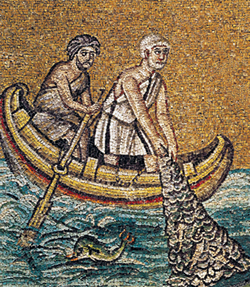
There is a common saying among Christendom, (clearly) amongst laypersons in particular, that Jesus called mere fishermen to be His apostles and, therefore, one doesn’t have to be deeply intellectual, scholarly, or have any special attributes to know, understand, and communicate God and the Scriptures. Accompanying this mindset is something similar to the idea of “seminary = cemetery,” an equally popular quip within the Church. Now, in sentiment such perspectives are indeed correct. One doesn’t need to have much of anything beyond a willing and humble mind to know, understand, and to communicate God to the world and to other believers. Additionally, Scripture is indeed written to the universal Church and therefore able to be grasped by all. And moreover, we have principles such as that in 1 Corinthians 1:26-29 (ESV):
For consider your calling, brothers: not many of you were wise according to worldly standards, not many were powerful, not many were of noble birth. But God chose what is foolish in this world to shame the wise; God chose what is weak in the world to shame the strong; God chose what is low and despised in the world, even things that are not, to bring to nothing things that are, so that no human being might boast in the presence of God.
But how is that going? That is, that one essentially has the capacity to “pick up the Bible” and understand it in perfect accuracy? I’d say we have a wildflower pasture in the Church (as every flower is uniquely beautiful, despite the issues to follow) where one’s own personal interpretation takes precedence and is a result of their own quasi-methodology of reading. Certainly, the uniqueness that each believer brings to the table from their experiences, relationship with God, relationships with people, unique framework of reading, etc., is absolutely important. In the scholarly realm the same concept can be likened unto those who specialize: specialists in particular areas of study bring an entirely unique approach to any given passage, pericope, or area of interest in Scripture. But ultimately we have an assortment of random individualistic belief programs that are all coming out of the same soil (the bible) but sprouting much differently. Wildflowers.
That analogy probably doesn’t work (I am certain most of my analogies don’t) but the gist is this: same material, different conclusions. But I use wildflowers to emphasize that they are essentially random, unordered, and somewhat a product of sporadicity and spontaneousness. While noble to pursue an organic and natural set of conclusions from reading Scripture—not letting dogmatic or theological presuppositions get in the way—we are actually applying our own self-formed dogma and theological presuppositions to the text. The authority and/or domain from which we draw is simply, instead, our own selves rather than systematic heritages, denominational catechisms, or doctrinal camps. This is, of course, eisegesis and not exegesis; reading into the text and reading from the text, respectively. This problem deserves its own article, or even its own book(s), and our focus here is on this specific ideology of the apostles’ simplicity and layperson positioning. What we have mentioned above is important, however, as this is ultimately where this idea comes from or where it arrives at. To keep this short and simple, let us rebut this idea by three main points (though many more could be made):
- The apostles, though mainly laypersons, were specifically handpicked and chosen by Jesus, and therefore incorporated into a divine and eternal mission. Sure, we are as well, but we are not in the same position programmatically nor are we in the same position practically: the apostles would have been given special revelation, especially as they were to write the canon we now study, and they lived with Jesus face-to-Face for some three years or so. We also have quite glaring examples of their unique exposure to the truth of the Gospels. Consider Luke 24:45 where the physician explains that Jesus “opened their minds to understand the Scriptures,” or even some verses earlier where Jesus, to the two unnamed on the road to Emmaus, “interpreted to them in all the Scriptures concerning Himself” (v. 47). I doubt, even in our Spirit-filled studies, “our hearts burn with us” in the same way it did for these two men “while He [Jesus] opened to us the Scriptures” (v. 32). Thus, the apostles (and by extension, the early disciples and Church) were uniquely disposed to special and elaborate knowledge—knowledge that really, only, could be given by the Son of God Himself. We are at a major “disadvantage” here, and such a gulf cannot be closed.
- The apostles were raised and saturated in an intellectual economy that held close to mind an unfiltered and natural understanding of the first testament (the so-called ‘Old Testament’), and demonstrated a very solid and deep understanding of this material (e.g., John 2:17 // Psalm 69:9). Now, this isn’t to drive an unnecessary and anachronistic dichotomy between the first and second testaments. No, not at all. But, it is to point out that (a) the apostles in the first century received the first testament in its “original” form, prior to it being filtered through post-Cross ideas, whether accurate or inaccurate. Moreover, and more to my point (as the above can be easily misunderstood), they understood the Scriptures prior to centuries, and millennia, of associated interpretations by later Christian minds. And (b) they had this material close in mind, heart, and memory. Commensurate with both points, we should recognize that in the modern Church there is not only a massive lacuna in our understanding of the first testament in general, but that this is evidenced clearly by the very fact that we need (or at least the need is perceived) for countless studies that are titled something like “How the NT uses the OT.” That these works exist (and are quite popular and successful, and are accompanied by a new one every year it seems) betrays a fundamental absence of the Church actually understanding the first testament in the first place. At the least, this places the apostles—and their peers and associates—within a much better understanding of Scripture, even if they did not yet have the remaining 41% (the NT). Having a better understanding of the foundational testament from which the second would blossom out of, they were better positioned to understand the second.
- The apostles, though mere fishermen, grew up in, lived in, interacted with, and lived through the original historical, cultural, Messianic, and contextual environment that birthed what we call the second testament; that which we may only peer into. This is the most important point, in my mind. Consider three subpoints: (a) the apostles were raised in the Second Temple period Jewish literature-religious economy, and thus would understand the cultural world in which the NT inevitably interacts with; (b) the apostles would understand the larger cultural world (i.e., the Greco-Roman world) within which the NT interacts and writes to and/or about, and (c) perhaps most importantly, the apostles would be fluent in the original languages the Scriptures were written in, as well as the cultural lexicon which informed the meaning(s) of words, idioms, figures, concepts, etc. This very simple but deeply profound and implicatory observation most aptly presents the divide between what is simple, taken-for-granted knowledge the apostles would have that we must, quite literally, study to supplement our lack of equal footing. To fully grasp the absolute simplicity of the biblical text, we must quite literally learn Hebrew and Greek in order to match these mere fishermen’s understandings. And that’s just one point. Potentially even more important (or at least equal or comparable) is closing the gap of their direct involvement with the immense and variegated cultural worlds (both society and literature) that we can only study via history, and even then we will never possess the same understanding of.
Essentially, the apostles were there, in that world, and we are here, in a much different world. And how much this impacts our understanding, approaches, and applications cannot be easily overstated. It is incumbent upon the honest, objective, and humble student of the Word—at any level, as this does not preclude any individual, and the endless mountain of knowledge rebukes any confidence we store in our hearts of “knowing enough”—to “close this gap,” as their full grasp of Scripture will always be limited by inevitably being removed from the literary world in which it was written. If we take a historically accurate approach to the events and writing of the Torah (Genesis-Deuteronomy), and therefore date the canon to 1500-1300 BC, then the apostles were closer to the time of Moses than we are to them, and by 500-700 years. Which speaks even more to our need. And what is that need?
Our need, therefore, is to supplement the massive chasm which separates us, the modern-day student, from them, the first-century recipients, by way of studying. Understanding the first testament and its subsequent Second Temple period literature interpretations, the first-century Jewish and Greco-Roman cultures and worlds, the original Hebrew, Greek, and Aramaic, and all that fills in those gaps is not merely an ideal, but to some extent a necessity to understand the Scriptures. It is not a matter of denying a believer’s ability to understand (fully) Scripture unless they go to seminary or what have you, but a very pragmatic reality in that we are immensely disadvantaged with respect to very simple knowledge critical to understanding the Scripture that these mere fishermen would regard as common knowledge. Studying is, therefore, less of an intellectual endeavor and more of connection: connecting ourselves to the original authors and audiences in their own “world.” Otherwise, and if we fail to do so, we will inevitably superimpose our own “world”—our own worldview, ideas, etc.—onto the bible’s, rather than allowing it’s world to inform our own. The result of that is simply and plainly the battle of eiesgesis versus exegesis.
I always say it, but I’ll say it again: when one goes to seminary they aren’t told why they need to know this, that, and the third to properly understand the Scripture, they are shown why. Just as we would ideally and naturally feel the need to understand, initially, the culture of a foreign country we were going to visit or move to, so should we feel the same with the bible. We must prepare, and “do our homework,” familiarizing ourselves with the cultural and literary world of the biblical authors and audiences prior to visiting Scripture’s world and walking its roads. While we’ll never see as if through their own eyes, or smell their world and fresh challah (?) baking in the alleyways, nor touch the same layer of ground they walked on, we can develop our intellectual senses to place ourselves in their sandals as much as we possibly can. Will there be an eternal (at least in this age) gap between us and them; between the original understanding and what we may (re)construct? Absolutely. But that is part of studying Scripture: we will never know enough. But we don’t have to. It is not, therefore, required of us to understand all things, but neither are we free from giving our best effort to most accurately understand the Scripture as it was originally received, not as it has been passed down to us—even if we are the ones passing it to ourselves.