
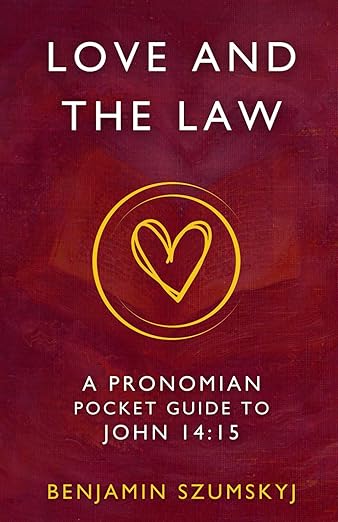
Clover, SC: Pronomian Publishing, 2025.
There are numerous rising voices in the pronomian (pro-Torah hermeneutic) world as it itself grows, and the future is full of promise for this branch of scholarship offering new trajectories and ideas into the larger scholarly and layperson conversations of Law, Pauline theology, etc. One of these voices is Benjamin Szumskyj (PhD, Liberty University), who I consider not only an associate within pronomian thought but a beloved friend. So my review of his recent work Love and the Law: A Pronomian Pocket Guide on John 14:15 may be subject to some bias, but methinks not. In this short and accessible yet thorough work, Szumskyj demonstrates his ability to easily navigate pastoral and thought-provoking approaches to Scripture while simultaneously upholding a rigorous exegetical approach. This is refreshing on numerous levels, yet primarily in my mind as Szumskyj (hereafter S) given the paucity of exegetically-astute studies in the pronomian field. As another contribution to the deeply interesting and promising Pronomian Pocket Guide series, S’s study perfectly balances a strong pronomian hermeneutic while touching on numerous related topics and points of interest and importance.
S structures the work by way of an introduction, five chapters, a conclusion and provides three appendixes in the back of the book. In the introduction S gives his stated directive in the introduction: “The contention of this book, then, is that the love of Yeshua [the Hebrew, and given, name for Jesus] is evidence in the life of a believer by living out the commandments, for an unchanging God and his unchanging attribute of holiness is the standard by which his commands are established” (p. 7). Such a statement is canvassed against a pronomian view which envisions the continuity of the Law of Moses within the life of the new covenant believer, and the introduction welcomes the reader into this idea and concepts which orbit it. Exploring this theme of continuity, S contends that “The commandment that was holy and brought him [God] glory yesterday cannot be declared as no longer holy today” (p. 9). Insightful points like this are scattered about the work, and due to its short(er) nature we will resist quoting S too much in this review.
In chapter one S asks the question over the “new commandment” in John 13:34. As is often claimed, S rejects the premise that this “new” commandment renders invalid or inapplicable the commandments of the Mosaic Law, offering instead that what it means to love God—i.e., the commandments in the Law—“have been enlarged, not eradicated” (p. 14), and this is how we ought to understand the “newness” of Jesus’s commands. In chapter two, S moves to an exegesis of John 14:15, the primary passage under investigation. Here S spends a significant amount of time contextualizing and examining the three words ἀγαπάω (“love”), τηρέω (“keep”), and ἐντολή (“command”). His treatment here is succinct and insightful, all while maintaining the application of the exegesis to the topic at hand, maintaining emphasis on the Law’s continuity within, specifically, Jesus’s articulation of it (in word and deed). Rightly insisting on the Law as being part of the believer’s sanctification, S comments that “the means of sanctification for the ecclesia [“church”] has remained unchanged since its inception at Mount Sinai. Through YHWH’s progressive revelation, it was enlarged with the arrival of the Messiah and his teachings” (p. 22), adding passing notes such as “Yeshua’s sermon on the hill in Northern Israel (Matthew 5-7) was meant to correct historical misinterpretations, not to abolish the Torah or establish a new set of commandments” (p. 23). Chapter two closes out with a wonderful excursus on discipleship, finishing off a chapter on love, keeping, and commandments quite well.
Moving to chapter three, S covers parallel passages in Johannine literature, particularly that of 1 John. Arguing that the commandments and traditions of men are what is burdensome rather than, erroneously, the Law (pp. 38–40), S argues what, in my mind, is his strongest point: upholding a high Christology, and a triunity of the Godhead (Trinitarian), we can reasonably infer that it was Jesus who was at least present at Sinai, but certainly active in the giving of the Law. This leads S to comment “What Yeshua commanded during his earthly ministry does not conflict with what he taught at Mt. Sinai as a member of the Tri-Unity…He is not saying that the Torah is a burden or that, having failed previously, Yeshua has now introduced a new body of commandments that will be less burdensome” (p. 41). S finishes the chapter with demonstrating how love is the furnishing of the Law’s commandments and providing an excursus on “WWJD [‘What Would Jesus Do’]? His Commandments!”
In chapter four S begins to move into his argument as it takes form with John 14:15. Here S takes the protasis “If you love me” and apodasis “you will keep my commandments” to be a third-class conditional sentence in similar fashion to the Decalogue’s commandments, which grammatically would render the verse something akin to “If you [presently] love me, then you will [go on] keep[ing] my commandments” (see p. 47). This, as S contends, “was not a love bound to a body of holy instructions that would cease within years of the statement being made…[but] continue throughout the life of the disciples…[and] to be emulated by all redeemed generations of those who would seek to follow the way of the Messiah” (p. 48), echoed in other passages like 1 John 5:3. S moves into the erroneous threefold categories imposed upon the Law (civil, ceremonial, moral) and notes the inconsistency thereof as well as pointing out that “the fact that no one in Church history has sought to list every law beneath each label is a telling statement” (p. 51), a very important observation. He finishes the chapter off on good works being a result of a believer, and not (nor ever) the means of justification / salvation.
In chapter five, a longer chapter, S argues for the beauty and importance of fellowship—with an emphasis on love—complete with an explanation of an acronym for the importance of fellowship and an excursus on ideal church theology. Finally, in the conclusion, S ties together his study which argues that “There is no reference, explicit or implied, that his [God] commandments—the source of spiritual food and the compass by which care is administered—are to be compartmentalized or divided,” and that “In fulfilling, not abolishing, the Torah, Yeshua lovingly gifted his Bride with instructions to live a holy life until his return and to be set apart from the ways of the nations that have rejected his commandments” (p. 80). In the three appendixes at the end of the book S writes on the Shema in Mark, God being light, and a brief explanation of the Gospel, respectively.
S’s work is a refreshing work in many regards and a welcome and important contribution to pronomian scholarship. He weaves in and out of various ideas which may, at first blush, seem irrelevant or hardly relevant, but as he charts his course it corrects such an assumption, reflecting a researcher bringing together important vantage points of Jesus’s love-charged expectation (or presupposition) of us keeping his commands, and these commands being no different than God’s given at Sinai. It is this insightful and pastoral application which characterizes the study and each chapter functions as complements to his overall argument. John 14:15 has long been a contested verse used questionably to envisage Jesus replacing the Mosaic Law, but S’s present work sets forth a strong argument making such an idea, and associated ones, clearly erroneous from an exegetical and a larger biblical theological perspective. Though S’s work could be significantly more expanded and encompassing, the intent—as a Pocket Guide—is clearly not that, but one is not left wanting, but simply wanting more on the topic from S. In the present work he masterfully tackles the topic, providing a work accessible to everyone including the scholar (S interacts with plenty of academic material, with a bibliography of 76 sources) and, in my mind, closes at least one chapter in the larger Law discussion in the NT.
2 responses to “‘Love and the Law: A Pronomian Pocket Guide to John 14:15’ by Benjamin Szumskyj”
Great review! I’m definitely going to have to purchase that book after I have finished the long and tedious process of reading Irenaeus’s Against Heresies. That book is longer than I expected it to be…
Anyway, God bless both yours and Dr. Szumskyj’s ministries! Shalom.
It is! I am sure you will enjoy Szumskyj’s work. Certainly shorter than Irenaeus!
Shalom,
Rick