
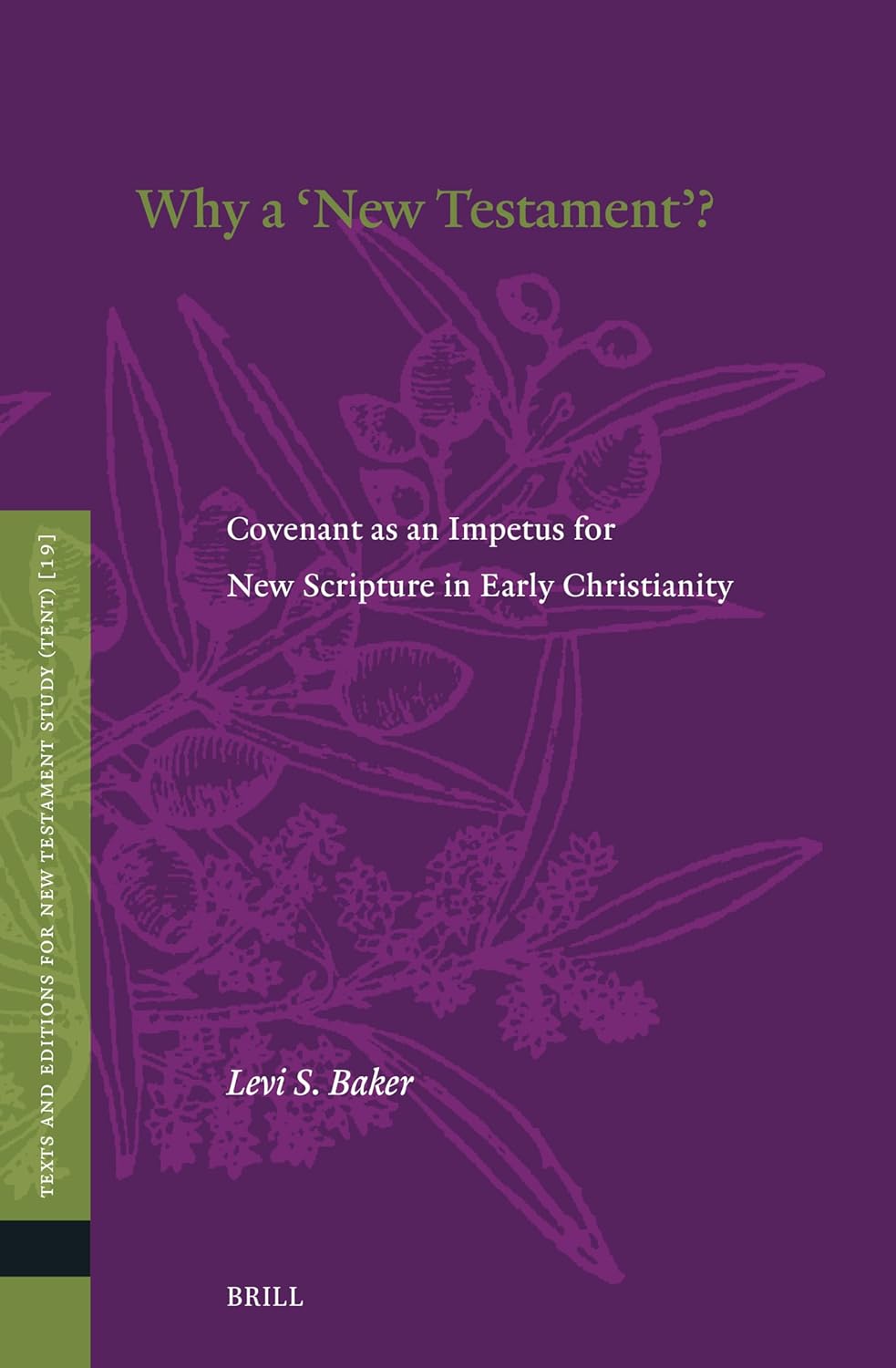
Texts and Editions for New Testament Study (TENT) 19. Leiden: Brill, 2025.
The topics of canon, covenant, and scripture have enjoyed significant scholarly works in the many centuries since their “creation”, and the academic world finds another wonderful and unique contribution in Levi S. Baker’s new title Why a ‘New Testament’? published through Brill (2025). The work is a “slightly revised version” of Baker’s (hereafter B) 2022 dissertation under L. Scott Kellum at SEBTS (p. xi). The work is neatly organized into six chapters and one for the conclusion, as well as a substantial bibliography (pp. 285-335) and helpful author, scripture, and ancient sources indexes (pp. 336-346, 347-356, 357-364, respectively). Being a Brill publication, the typesetting is elegant and print quality excellent, as expected. Unusually so, the work does contain several minor spelling and grammatical issues scattered across the work, but obviously has little impact upon the quality of the work. In all, B’s work is a remarkable contribution to the area of research. His arguments are tightly and carefully made, his footnotes (totaling 1,156 across all seven chapters) contain in themselves a whole other book, and his consideration of different, relevant, and complimentary views leave the reader with a work that is thoroughly enjoyable, insightful, and cemented as a reference work that will be returned to for topics even beyond B’s main thesis and concern. In sum, I would strongly recommend B’s work to any and all concerned with and researching the junction of canon, covenant, and scripture and the “canon consciousness” of the biblical literature and its writers and readers.
B’s thesis is, as the title suggests, that “covenant” was an impetus for the creation of the so-called “New Testament” (NT), and that the ushering in of the new covenant by Jesus warranted, and would have left early Christians anticipating, corresponding covenant literature (what B calls “covenant documents” frequently in the work). Essentially, throughout the chapters B traces the theme of “covenant” being proceeded by “covenant documents” in the Hebrew Bible (HB), Second Temple Period (STP) literature, Qumranic (DSS) literature, and subsequently within the NT itself and first- and second-century Christians. Following the fascinating and excellently explored first chapter introducing the concepts of canonicity and its scholarship, this marks the structuring of each respective chapter of the book, culminating in the conclusion chapter (seven) which summarizes the thesis, findings, and presents future research. B is careful to define exactly what is and what is not his thesis. As he states, “this study’s research focus is not primarily the process of canonization, but instead the internal stimulus for receiving the NT writings as scripture alongside the HB” (p. 8), being a modified approach similar to Early and Internal Impetus (EII) model(s) which “focus on weighing the evidence for an early canon rather than explaining its impetus” (p. 19), similar to Grant, Kümmel, Metzger, and “to a lesser degree” Lohse (ibid.).
For B “the impetus for the NT canon and the canonical status of the NT documents from the beginning are related to the authority of the HB and Jesus tradition” (p. 21) in reception of the Jesus tradition, and B takes as influential both Hahn’s close assoequal footing to that of the HB. Some aspects integral to B’s analysis are “the impetuses to inspiration, the apostolic tradition, regard for the words of Jesus, concern for public reading, and the history of redemption” with respect to the canon, cult, and liturgy elements found in HB, STP, and early Christian (EC) ideas (p. 35).
These general ideas describe the substance of chapter one, as B navigates through the wide bush of scholarship on the canon and its development, touching on various points and aspects of the discussion relevant to his thesis yet prudently distancing himself from fully investigating or interacting with any. Throughout the book one finds several mentions of the study being unable to address various topics, which is comforting to see B plenty aware of their importances. The rest of chapter one is spent on 1 Tim. 5:18 and 2 Peter 3:15-16 and the “canon consciousness” of these authors and their recipients. This section (pp. 37-52) contains a fascinating and unexpected overview of dating both epistles as well as speculating over their authorship, with B providing sufficient evidence pointing to earlier dates but remaining agnostic to any conclusive comments or ideas thereof. B’s main point is that, given earlier dates are considered, the passages connote a “canon consciousness” in the early Christian era, providing further evidence for early Christian expectation and acceptance of revelatory, written documents following the new covenant in Christ. In the final pages of the chapter B outlines some further definitions and reiterates again (which he does frequently, as necessary given the ease in which his thesis overlaps or is morphed into others) that “this study proposes to explain a theological impetus for the reception of new scripture alongside an existing body of Israel’s Scriptures and therefore explains the beginning stages of the canonical process rather than its ongoing development and closing” (p. 54). This is where, in particular, B’s thesis shines through and is a promising contribution to scholarship as it, rather than becoming entangled in canonical development, collection, and closing discussions, B looks at the motivation and welcoming attitudes for a NT canon in the first place. Looking back to the HB, for EC, “The pattern within their sacred texts would set the pattern that they would follow” (p. 59).
In chapter two, B’s title aptly describes the content: The Hebrew Bible Foundation for a Scriptural Expectation. Here B provides a fascinating overview of covenant, treaties, and covenant documents which would follow both covenant acts and covenant renewals. In my mind, B’s overview of the relationship between the covenants and his various arguments for the Mosaic covenant being central to the ongoing covenantal spectrum in God’s redemptive history and section on the Covenant Code is one of the pinnacles of the book (pp. 66-72, cf. 74-76), but the chapter’s main focus is certainly on the covenant à covenant document section (pp. 72-81) which he applies to Deuteronomy (ibid.), Joshua 24 (pp. 82-88), 2 Kings 23 (pp. 88-90), and Nehemiah 8-10 (pp. 90-97), finishing off with Jeremiah’s new covenant (pp. 97-103). In these sections B traces the covenant à covenant document theme, but also the pattern of sacrifices, communal meals, and the public reading of the documents. This theme continues in his next chapters when analyzing texts. Equally important is his overview of the expansion and supplemented addition of material to the renewed covenants within their text, a pattern he shows to be well documented, and contributes (somewhat unsuspectingly) to his thesis (p. 104):
This pattern of repeated reaffirmation and ongoing supplementation of the covenant documents provides a crucial model for first-century Christians. Believing that the new covenant had been inaugurated, they received new covenant documents while retaining their received covenant documents (Israel’s Scriptures).
B adds to his analysis, following James W. Watts, the “ritualization” of texts via “semantic”, “performative”, and “iconic” dimensions (p. 104), which primarily operate through a text being the object of study, private and public readings, and particular ornamentation and handling of it/them (p. 105). Concluding the chapter, B argues that “the HB evidences a covenant à covenant document pattern, a tight conceptual link between covenant and scripture, and an expansion of the covenant document as the covenant is repeatedly renewed” (p. 110), adding to his thesis that “early Christians would follow in this general expectation (p. 111).
Moving to chapter two, B navigates through the STP literature, primarily focusing on the Apocrypha (1-2 Maccabees and Sirch; pp. 115-122), Pseudepigrapha (2 Baruch, 4 Ezra, LAB, Jubilees, Temple Scroll, and Testament of Moses; pp. 123-143), Philo (pp. 144-146), Josephus (pp. 147-149), and other evidence (pp. 149-151). Here B sheds light on canonical consciousnesses existing in the STP literature, even if no canon proper seems set or explicit. In pp. 132-144 B investigates the phenomenon of “rewritten scripture” in the STP and its various implications for the idea of “canonicity” and “scripture” in the era as well as associated covenant documents. For his purposes, “Concerning the notion of ‘covenant’ and an openness to new scripture, the evidence is less pervasive…yet still impressive,” and “the potential for a covenant renewal ceremony followed by new scripture counts as moderate evidence” (p. 151), but on the other hand “the reception of the HB in whole or part as a covenant document is pervasive,” and “some 2T Jewish works were amendable to or claimed to be new scriptures in a manner that was connected to the notion of covenant,” which is an important thematic observation for Christians to receive further covenantal documents (especially written) in similar fashion as the STP environment demonstrates (p. 152).
Chapter four, quite unexpectedly, is probably my favorite chapter. I believe B has inadvertently (?) written one of the most succinct, unique, and fascinating chapters tying in Qumranic studies into his thesis, which is only accentuated by the fact that these chapters (on DSS, that is) often feel forced, only provided since it is expected that one interact with the DSS. Instead, B writes a captivating overview of the Qumranic community, their reception and understanding of extra literature and the creation of their own, as well as their literary and preservation care of their scrolls. B does maintain the consistency of his focus on his thesis, pointing out that “While questions remain surrounding the [Qumanic] scriptural collection’s structure, the community had a concept of received sacred scripture and a body of scripture that included books shared with broader Judaism” (p. 159), and the importance of Qumran given that they were, other than those behind the NT, the only other group in STP Judaism that regarded themselves as a new covenant community, especially one with new covenant documents (pp. 164-167). The authors of their literature strike a parallel to Sinai (p. 170; here 1QS), the documents fit the ritualization of texts (p. 173-175; cf. 104-105), and other scribal, textual, and manuscript details suggest that some of their documents resemble canonical characteristics (pp. 176-185) often, and otherwise, reserved for scripture proper. B’s section of the preservation of 1QS and other documents (pp. 185-191) is an unexpected gem and beautifully executed. B provides other criterial analysis to DSS in the remainder of the chapter, closing it out with an emphasis on the Qumranic communal meals (where scripture would be read) which parallel EC’s early Lord’s Supper celebrations (p. 196) and the fact that Qumran serves as a parallel community which received (new) writings as “new covenantal revelation” (p. 197).
Seeing how “the DSS community offers a parallel for early Christianity,” as well as the larger STP environment, B begins chapter five noting that “the connection between covenant and scripture was part of the theological soil of 2T Judaism(s) in which early Christianity took root” (p. 198). B begins by surveying the fundamentals of EC and how the various “convictions provide all the ingredients for new written scriptures of the new covenant” (p. 203), primarily in that Jesus’s actions and subsequent apostles and NT authors’ works would be understood and received “as the continuation of their scriptural story” (p. 206) with the HB. B breaks this chapter into an analysis of 2 Corinthians 3 (pp. 207-210), the Gospel of Matthew (pp. 210-234), and James 2 (pp. 235-238) and Hebrews (pp. 238-242). He admits this section is “non-exhaustive” (p. 242), and that is true—however, it is beyond this review’s own scope to begin to unpack the significant data and points B extrapolates and makes in the section on Matthew. In short, the aim of the chapter is to see how this literature presents itself as new, continuative covenantal literary works constituted in some capacity as covenantal documents.
In his final chapter proper, B investigates what he calls the “pre-Irenaeus limit” of EC literature in the second century. Noting the established titular use of “covenant” prior to the close of this century (p. 245), the emerging distinction of “encovenanted” documents and the distinction between the (so-called) old and new testaments (p. 247), but insisting on focusing specifically on the connection of covenant and scripture (p. 248), B spends this chapter on the Didache (pp. 253-259), the Epistle of Barnabas (pp. 259-266), Justin Martyr (pp. 266-271), and summarizes that “there is significant, early and geographically-diverse evidence for the reception of the Gospels (especially the [Gospel of Matthew]) as new covenant scripture” in this literature (p. 271). This chapter is good, but it inevitably lacks the vigor of the previous chapters. This is, however, an inevitability given the corpus under investigation. The tenor is to demonstrate that such a covenant à covenant document theme continued in EC and compliments chapter five’s focus on the NT. In chapter seven, B draws together his findings. Tracing the general theme of covenant à covenant documents in the HB and that in renewed covenants “the received covenant document is retained and supplemented by the writing of a document detailing new covenant stipulations…[:] as covenants are made, the covenant document expands” (p. 275), a pattern shown in the STP (p. 276), the potential parallel of Qumran (p. 277), and that these intertestamental witnesses strengthened the mindset to be found in EC. Therefore, B writes that “the results of this study suggest that early Christians…found in the HB a model for the reception of new covenant scripture” (p. 280) and that this mindset, besides the typical foci of canonical development, demonstrates that in “the first and second centuries…an early and robust canon formation was underway” (p. 281). This leads B to claim that the decisive period of canonical formation was actually the first, and that “the reality of scripture-seeking impulse arising naturally out of early Christian theology has implications for dating early Christian texts,” and that “one should not be surprised” to find this, “For the early church’s canon was the natural response to God’s redemptive and revelatory work” (p. 282).
Why a ‘New Testament?’ is altogether a well-written, incredibly executed, admirably researched, and captivating study that deserves a place on every shelf, and will certainly find itself in countless future studies—undeniably landing a place at minimum in footnotes, but certainly providing an incredibly important and insightful vantage point of the intersection of canon, covenant, and scripture which warrants interaction with every researcher on the topic. I would warmly and heartily recommend B’s work, and believe that his footnotes alone warrant the price, which truly is (as mentioned) a whole other book in and of itself, let alone the study as a whole! I enjoyed the work thoroughly, am walking away from it enriched and learned, as well as having many new curiosities piqued in me. B has accomplished a wonderful feat and I eagerly await more research from him and the contribution his work will bring to the scholarly community.
Special thanks go to the publisher, Brill, for providing a complimentary copy of this work. My review reflects my honest opinion and is in no way influenced by the publisher or receiving of the title.