
Downers Grove, IL: IVP Academic, 2025.
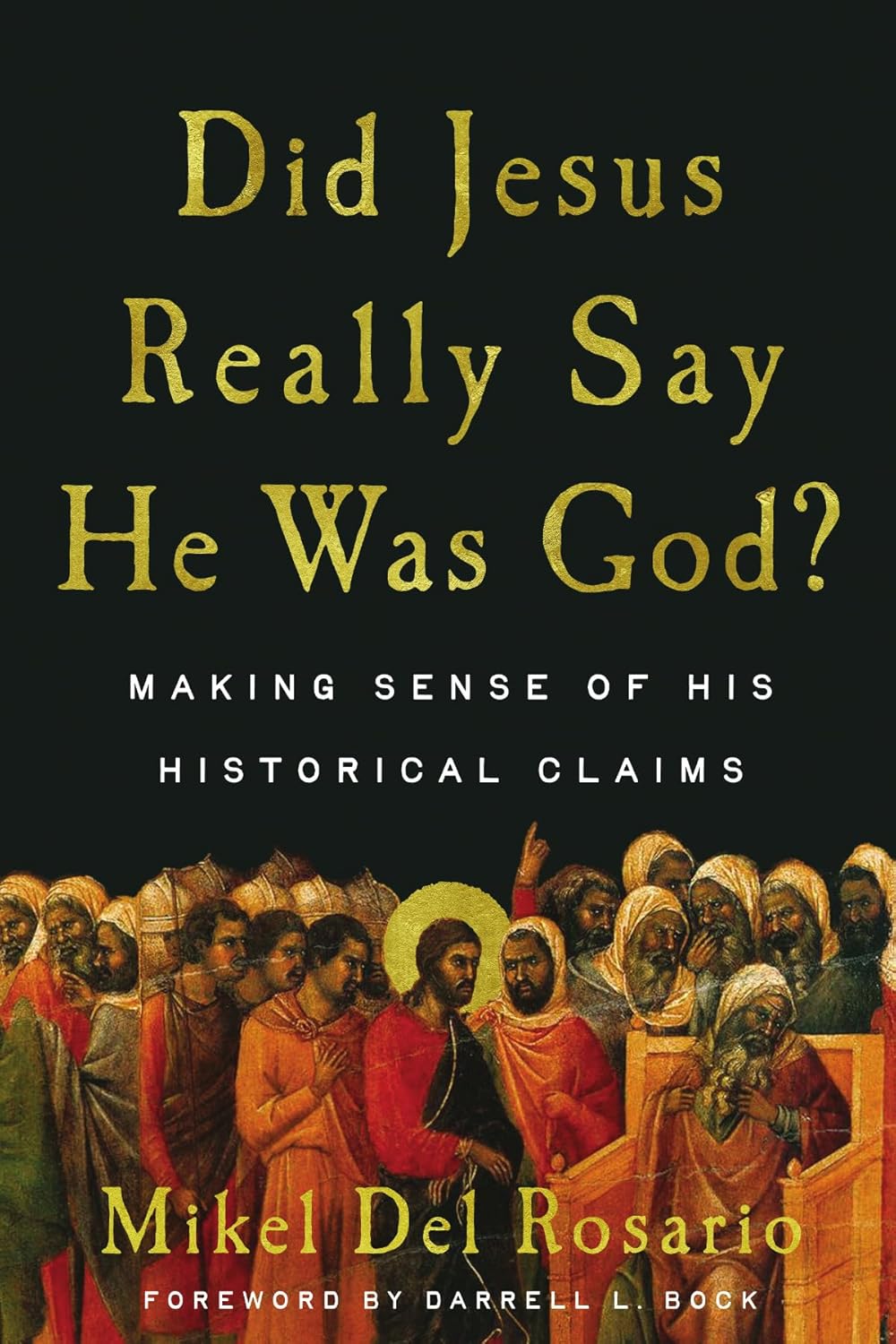
The historicity of Jesus and reliability of the Scriptures are problems which most Christians face and often find themselves ill- or underprepared to mount a defense for. While in the academic world such topics are entreated at length, and amongst themselves scholars dialogue over these and related topics, the layperson is seldom provided sound, robust, and accessible resources to mount defenses for the historical figure of Jesus and many of his claims recorded in the four gospels. Mikel Del Rosario’s recent publication Did Jesus Really Say He Was God?: Making Sense of His Historical Claims (IVP, 2025) certainly fills much of this gap. Del Rosario’s (hereafter DR) book not only thoroughly introduces his readers to historical analysis and scholarly conventions in approaching religious and secular literature but also provides a strong defense for Jesus’s claims of divinity (deity) against the literary and cultural environment of his day. Though written for the layperson (as it seems), DR interacts with a sufficient among of scholarly works and balances well the rigor one needs in Historical Jesus studies while being approachable for those of any background. Did Jesus Really Say He Was God? positions itself as a work, therefore, that can be appreciated by scholar and gleaned immensely from by layperson, and should be recommended and required reading for seminary students and churchgoers alike. Though the work may seem repetitive at times for those familiar with Historical Jesus research, DR masterfully brings the reader back to “pure historical analysis” throughout the book, refreshing its reader that the bible can stand up—and indeed, succeed in—critical historical analysis. The work leaves one prepared for defending the faith, and particularly in defending Jesus’s claims of deity. Though likely inadvertently, I believe DR’s book simultaneously establishes the trustworthiness of Scripture itself and prepares those who read it to apply the same methodological approaches to other areas of Scripture.
DR’s work is a revised edition of his PhD dissertation at Dallas Theological Seminary under the supervision of Darrel L. Bock, who provides a brief foreword to the work (pp. ix-x) and is cited frequently throughout the work. The title is divided into twelve chapters within four parts: part one, which contains chapters one and two, introduces the reader to historical research and the methods of analyzing, (re-)constructing, and verifying history. In parts two and three, which contain chapters three to five and six to nine, respectively, DR tackles the foundation of his study which is Jesus’s healing of the paralytic in Mark 2:1-12 and his examination by the Jewish leaders in Mark 14:53-65, respectively. In part four, chapters ten to twelve, DR draws together many of the points and observations made throughout the work and applies it to a wider degree of Jesus’s deity. The book contains a helpful glossary (pp. 205-208), a sufficient bibliography (pp. 209-220), and helpful General and Scripture indexes (pp. 221-222; 223-226).
In the Introduction, which precedes the work, DR introduces the work, the need for it, and the approaches he will take in it. In light of personal experiences and popular discussions on the historicity of Jesus and if he claimed to be God, DR shares what he sees as the need of warranting the study and his intentions for it to be pedagogical and to equip believers in navigating these discussions. Chapter one is described well by the chapter’s subtitle “How Historians Discover Past Events” (p. 3). DR asks the important question “What is history?” (p. 5) and this chapter follows to show how secular and religious historians “operate.” DR writes that historiography is the means and methods by which historians uncover historical knowledge (p. 6) and defines history as “a narrative account written to explain past events based on what a historian believes is the best interpretation of the surviving traces of those events” (p. 17). Seamlessly moving to chapter two DR introduces the approach in the book and outlines historical approaches which are the “best practices for studying Jesus as a figure in ancient history” (p. 21). He discusses the five criteria of historians: plausibility, explanatory scope, explanatory power, less ad hoc, and illumination (p. 24), which he applies in his analyses of the events, applying a spectrum of im/probability and un/historical ratings (pp. 25-26). What DR instills in the reader’s mind is the need for “historical bedrock” (pp. 26-27), providing a ground up analysis. He also looks at the rules of multiple attestation (p. 28), dissimilarity (pp. 30-31), rejection and execution, coherence (ibid.) and embarrassment (pp. 31-32), as well as contextual plausibility and inherent ambiguity (p. 32).
As noted above, DR touches on larger ideas than that which he is directly concerned with. For example, in analyzing the specificity of the bible’s recording of Jesus’s words DR notes that for the gospel authors, “While they wanted to accurately communicate the gist of a saying, they were not generally concerned with meticulously recording the person’s precise words” (p. 36), adding that “Even in a dialogue, ancient authors could be accurate without being precise” (p. 37). These types of comments are found throughout the work which takes a logical and defensible position on trusting the bible as Scripture. Simultaneously, DR often points out the logical fallacies and general erring of many thinkers, bringing the study to core analytical examination as the proper and planned approach.
Fully prepared for the two Markan scenes, DR spends the next three chapters employing what he has introduced the readers to. Within these chapters is an insightful and careful exegesis and analysis of Jesus’s healing of the paralytic and declaring himself able to forgive sins. DR demonstrates himself to be familiar with the spectrum of literature on the topic, but does not inundate the reader or recapitulate the history of scholarship. He introduces the historical validity of the account (Mark 2:1-12), Jesus’s reputation as a healer, and succinctly dismisses ideas of a “divine passive” (pp. 58-59) in chapter three. In chapter four, DR surveys ancient literature on people being able to forgive sins, answering claims that Jesus—by forgiving the paralytic’s sin—was well in his cultural setting, and therefore not claiming divinity (pp. 66-71). This section is done quite well, and DR shows how counter claims to this point misrepresent the data and fall victim to fallacious interpretive methods. DR also dismisses the validity of seeing Jesus acting within the realm of priestly forgiveness: “No text indicates that priests ever purported to forgive sins” (p. 74). He finishes the chapter off with a short but cogent idea of blasphemy in the ancient Jewish world (pp. 79-81) to which he returns later in much more detail. Chapter five continues to look at Jesus’s authority to forgive sins, combatting frequent claims one finds in popular and scholarly writings. He then closes this chapter, and this part, applying the spectrum of historical certainty (pp. 92-93), concluding the account as “very probable” and denoting Jesus’s claim to being divine (p. 94).
In part three, DR moves to the blasphemy accusation scene of Mark 14:53-65. He briefly surveys some popular claims, reiterates approaches, looks at the historicity of the high priest Caiaphas (pp. 102-103), and examines the core scene (pp. 105-107). Applying the criteria discussed earlier, DR investigates the event and its im/plausibility (pp. 107-111). In chapter seven DR takes a welcome turn into examining Jesus’s words in their first century Jewish context, placing Jesus squarely in this world. Against claims that none of his disciples were present at the event, DR often (ex., p. 116) points out throughout the work that given the longstanding Jewish-Christian debates after Jesus’s resurrection the details would certainly have been well-known. DR focuses on Jesus’s use of “Son of Man” language in the religious and literary environment and focuses on the significance of Jesus’s claim to be the eschatological “Son of Man” judge, warranting the high priest’s strong claim of blasphemy. This section (pp. 122-126) leads up to the next chapter, which I find to be the strongest in DR’s work.
There, DR focuses on the implications of Jesus being the judge and the idea set against Second Temple Period Jewish literature. This is done by looking at the authenticity of the high priest’s response (pp. 128-130), him tearing his garment (pp. 131-132), the idea(s) of blasphemy (pp. 132-138), and the logic of the result of Rome crucifying Jesus (pp. 139-141) which all corroborates towards the importance and significance of Jesus’s response. Jesus, as DR argues, is presented as the Davidic and eschatological judge, and particularly the judge of these religious leaders, solidifying the validity of the Markan event and the manner in which the leaders would have reacted. Chapter nine continues, extrapolating upon the divine claims here, dismantling views such as idealized human claims (pp. 145-147) and arguing, instead, that Jesus is indeed claiming divinity in not just the plain reading of the text before us, but in the religious, social, and cultural implications of the day. This chapter is just as good as the previous one, showing DR to be fair, balanced, informed, and a very careful and considerate scholar. Like the previous part, this chapter ends employing the spectrum of historical certainty (pp. 149-152), showing how the event is not only highly probable, but that it should be trusted and taken as authentic.
In part four, DR synthesizes and summarizes what the book has accomplished, as well as spelling out more details. Looking back to Mark 2, he writes that views are incorrect in seeing “petitionary prayer as a metaphor for forgiveness,” in that “there is no compelling reason to hold that Samuel, Daniel, or the seer [4Q242; pp. 67; 70-73] were believed to actually forgive sin,” and for priestly notions, “no human being was believed to have the authority to deviate from divinely sanctioned methods of mediating forgiveness (i.e., a sacrificial requirement in the temple” (p. 162). The rest of this chapter (ten) finalizes DR’s rebuttal of popular views, and in chapter eleven he does the same. These chapters do seem like they could have been omitted, being highly repetitive at times, but they are in actuality important and pull together the two events under analysis. DR also adds a good bit of information here, driving the nail all the way into the substrate on common arguments’ coffins.
Finally, chapter twelve is a refreshing read if one was, in fact, finding themselves with no conclusion proper of the work or, as I admittedly felt, wondering if DR was going to look at any other important passages throughout the work. His work is limited in scope, but here DR succinctly brings together his arguments, implications for other passages, and briefly surveys numerous points which, in collaboration, bolster the idea of Jesus’s deity. This is not to say the chapter is a dense argument for an early high Christology, but it is certainly a nice bit of icing on the cake DR has baked for the reader and closes the work out quite well. In short, DR has given the believer, student, or anyone for that matter, an introductory work to historical research on the gospel accounts of Jesus as well as a pretty iron-clad argument for Jesus’s claims to divinity in these two Markan accounts. I find myself to be rather critical and skeptical of most studies and their use of data within these topics, but DR has a carefully written, well-researched, insightful and accessible argument that truly positions Jesus’s claim to divinity as not implicit, but explicit once the hood is lifted a bit on the text. I would strongly recommend his work to all interested in historical Jesus research, defending Jesus’s claims to divinity, and do think it would be a perfect work for an introductory class in undergraduate biblical studies as well as for those who finding themselves being challenged over these types of claims. One will find the work to be one which equips and encourages, engaging with many scholarly works and arguments while maintaining an accessibility which fosters a learning from all who read it.
I was provided a complimentary copy of the book by the publisher, IVP Academic. The opinions reflected above are my own and are in no way shaped, influenced, or altered by receiving the title.