
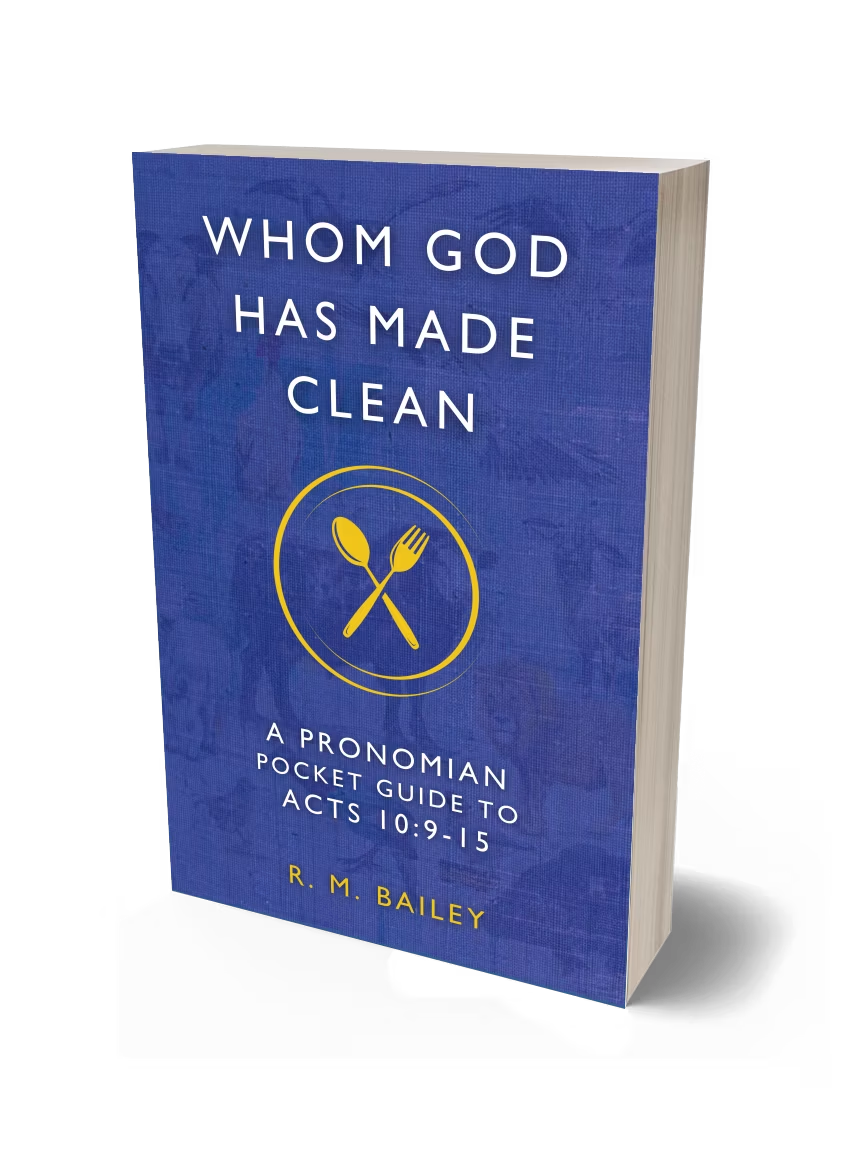

Fittingly for the first post of this new website endeavor, I am happy to announce my first book through a publisher, Whom God Has Made Clean: A Pronomian Pocket Guide to Acts 10:9-15, published by Pronomian Publishing. The Vision of Peter stands as one of the more enigmatic yet unappreciated situations in Luke’s Acts, and my contention – and that which I spell out in the work – is that it has gone unprobed and unmined for both its exegetical gems and Second Temple Period Judaism motifs. My essential argument is, similar to that of Jason Staples’s1 arguments, that Luke’s use the use of clean, unclean, and common animals is meant as a symbolic representation of the nations, drawing from such a literary motif practice found in 1 Enoch’s Animal Apocalypse. Following the writing process, I stumbled across another fascinating treatment seeing a similar possibility2 amongst other things.
Written to be short(er), accessible, while still maintaining exegetical acuteness, I am confident the work will present itself as a valuable and challenging contribution to the conversation not only over the Mosaic Law’s relationship to the new believer but also into the larger ideas of reading the New Testament “within Judaism.” It is an honor and a privilege to have the work, also, within Pronomian Publishing’s Pronomian Pocket Guide series, which I believe will show itself to be a promising and valuable series in the Messianic / pronomian viewpoint(s). For any and all who are interested, the book is available via Pronomian Publishing’s website and on Amazon.
Shalom!
- Jason A. Staples, “‘Rise, Kill, and Eat’: Animals as Nations in Early Jewish Visionary Literature and Acts 10.” Journal for the Study of the New Testament 42.1 (2019): 3-17. ↩︎
- See (along with my forthcoming review of his work) Zachary K. Dawson, The Message of the Jerusalem Council in the Acts of the Apostles: A Linguistic Stylistic Analysis. Linguistic Biblical Studies 22 (Leiden: Brill, 2022), 133-173, esp. 162-165. ↩︎