
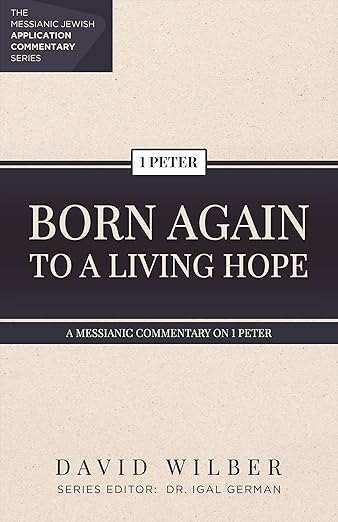
Messianic Jewish Application Commentary Series (1 Peter). Clover, SC: Pronomian Publishing, 2025.
Introducing what will certainly be a promising and exciting new commentary series, David Wilber’s recent publication Born Again to a Living Hope: A Messianic Jewish Commentary on 1 Peter (Pronomian Publishing, 2025) beautifully sets into motion a trajectory that I am deeply looking forward to. There exists very few treatments—of any kind, too—on pronomian views and approaches to Scripture, and whenever one comes forth, it is something to be quite excited over. However, Wilber’s work is not just a contribution to Messianic theology and pronomian exegesis, but to Petrine scholarship as a whole. The commentary epitomizes succinctness, seamlessly draws in cogent exegesis, and beautifully draws out application meanings throughout the work. In short, it is a very good commentary and Wilber continues to demonstrate himself as a capable writer and researcher. The descriptions above detail why I endorsed the work after Wilber provided a pre-publication copy for feedback. As I wrote,
In Born Again to a Living Hope, Wilber has masterfully gifted the believing community with a study on 1 Peter that perfectly balances exegetical diligence with clarity for all audiences to benefit immensely from. This short yet deeply stimulating and insightful commentary provides the reader with all they could ask for and belongs on every believer’s shelf, taking its worthy place among great studies on Petrine literature.
Concomitant with the shorter length of the commentary is its weaknesses, and Wilber’s work is, and should be, judged on the basis of the goals which it attempts to achieve. I would say that if one is indeed seeking an exegetical investigation of 1 Peter, Wilber’s work is certainly not their best option—at 136 pages, it would be simply impossible for him to have committed to such a task. Instead, the work is written to and intended for the layperson, but this comes not at the expense of “exegetical diligence.” The commentary series, titled the Messianic Jewish Application Commentary series, is modeled after NIVAC, and therefore one finds the text itself; interpretation and exegesis of the section; and a short section on applying the material to a believer’s life.
Rather than recapitulating all of his points, Wilber offers three primary views which make his work unique, in my mind. The first is a post-supersessionist reading, which is important. As he quips, ‘The only “supersessionism” found in 1 Peter is his call for his Gentile readers to supersede their former pagan way of life with a new way of life rooted in the Messiah’s example and the Hebrew Scriptures’ (p. 22). Secondly, he maintains, as expected, a pronomian viewpoint. For instance, he properly connects Leviticus’s Holiness Code to 1 Peter 1:15, writing that ‘Peter considers Leviticus to be a guide for defining holy conduct’ (p. 44). The third is an interest in views which remove themselves from typical Protestant and Reformed ones, such as that of the doctrine of election, moving into exegesis which is neither evangelical nor not evangelical, but rather simply committed to the text itself and alone. Wilber provides some discussion on these types of passages in 1 Peter (pp. 56-57) which begins a fascinating analysis of Gentilic inclusion according to 1 Peter (pp. 56-62) as set against the prophetic anticipations thereof. Wilber also provides sustained discussion over the contested cluster surrounding 1Peter 3:18 (pp. 83-89), defends the importance of apologetics (p. 91 et al.) and even tackles head-on the contested 4:6 (pp. 97-99).
Many more details could be elaborated on in more detail, but commensurate with the length of the book we leave a shorter review, and obviously one significantly shorter than our usual reviews! In sum, Wilber’s work is great. It is short and to-the-point, full of sufficient surveying of scholarly views on various points, and insightful in many ways both theologically and pastorally. No matter one’s doctrinal commitments or backgrounds, Born Again to a Living Hope is a wonderful contribution to Petrine scholarship, as well as biblical scholarship as a whole, and would prove helpful for any reader of any background. 1 Peter tends to be a neglected area of Scripture, and I believe Wilber closes this gap even more—Lord willing we will get something on 2 Peter out of him, too! This work is also a wonderful example for the MJAC series to build upon, and I eagerly look forward to future works from this promising new series.