
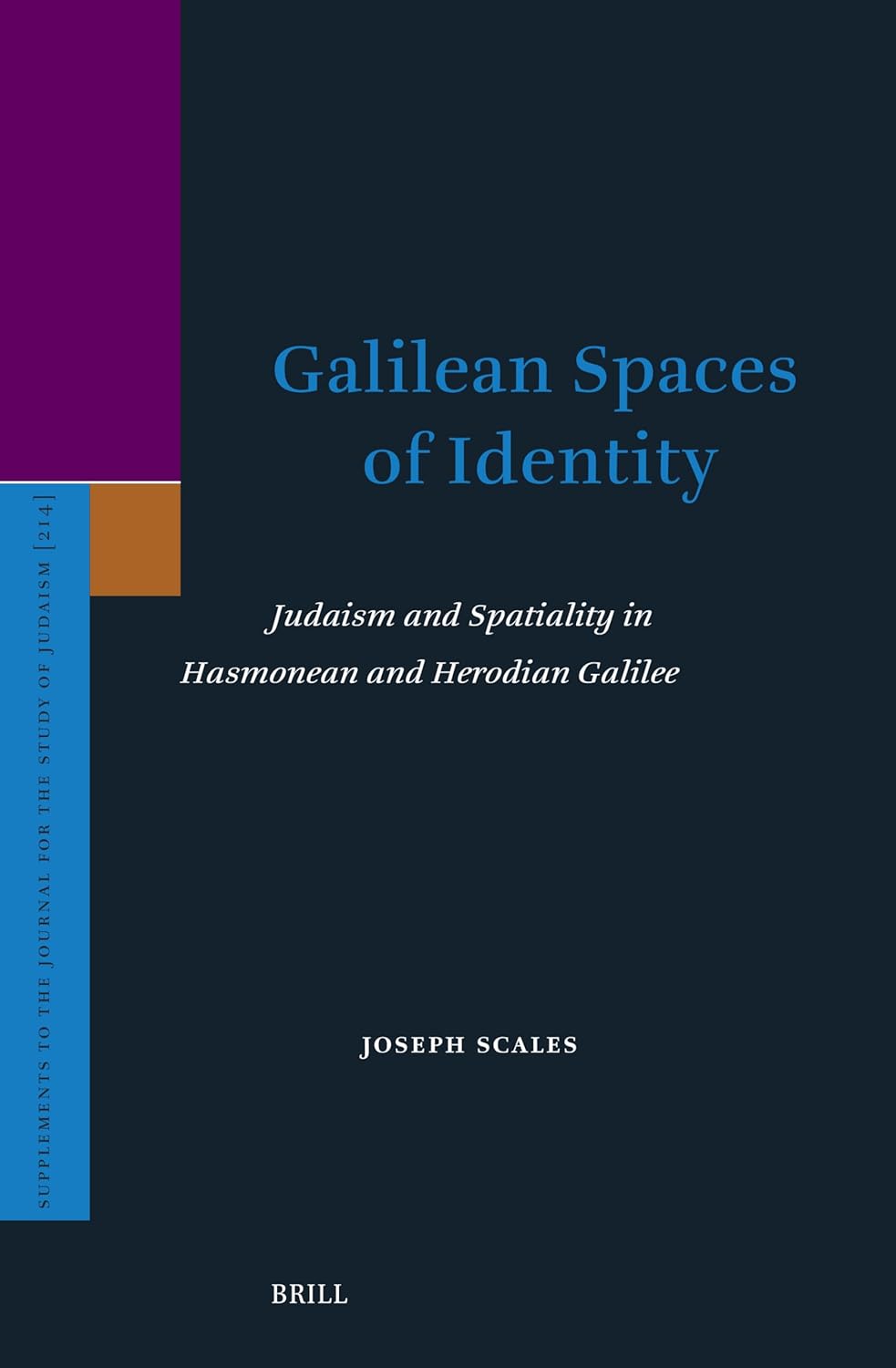
Supplements to the Journal for the Study of Judaism 214. Leiden: Brill, 2024.
In the last couple of decades the scholarly landscape has come to be dominated by studies on im/purity within the Second Temple Period (STP). Contributions from brilliant minds (with brilliant studies) such as Yonatan Adler, Ronald Denies (1993), Yitzhak Magen (2002), Jonathan D. Lawrence (2006), Christian Frevel and Christophe Nihan (2013), Stuart S. Miller (2015), Eyal Regev and others (here naming just a few) have contributed massively to contextualizing the intersection of im/purity, the Galilee, and the STP environment which would produce the New Testament. Among this list, and close to the top, should be placed the current work by Scales (hereafter S) not only given its contemporary status within the scholarly discussion, but also due to the depth of the work and the novel approach S here takes. The work is a revised version of S’s 2020 PhD dissertation completed at the University of Birmingham. In his Acknowledgements, S makes mention of Ronald Deines and Karen Wenell, and you can certainly hear throughout the work where S—and anyone, for that matter—would likely have gained significant insight from either of them. This is an opportunity to make mention that S’s work, in many ways, draws from numerous studies in this general area of research, not only capstoning many of them but drawing out the implications to present what is, to me, an entirely unique work.
S structures the book in seven chapters which include an introduction (chapter one) and a conclusion (chapter seven). In the Introduction, S investigates the historical background of Galilee, the presence and influence of Hasmonean presence, and defines both ancient Judaism and ‘place’ and ‘space’, from the study of spatial theory, and maps this onto Jewish ‘space’ within Galilee. Chapter two is an archaeological and literary investigation of purity culture in STP Galilee, mostly focusing on immersion pools and stone washing vessels. This moves S into chapter three, where he looks at the concept(s) and idea(s) of purity in STP Judaism, a quintessential example of providing a succinct treatment to an otherwise very complicated topic. Chapters four and five somewhat mirror chapter two, where S looks at Jewish communal structures (intentionally foregoing the term ‘synagogue’) architecturally and textually, respectively. In chapter six S draws together the findings to point out the space created in Galilee as not an extension per se, but “looking” to Jerusalem, defining Galilee as a ‘regional space.’ Finally, S provides a brief conclusion, an extensive bibliography (pp. 317–371) and indexes.
In introducing the goal of the book, S sees the work answering the question “how did ancient Jews create meaningful spaces of religious activity in ancient Galilee, and how did those spaces in turn influence the constitution of ancient Judaism?” (p. 1). For S, the need comes by way of the lack of applying spatial theory from studies despite providing a plethora of data and discussion on the archaeology. Thus his work paves a novel way forward and to examine the relationship between these two which unveils a “collective ideology” in ancient Galilee space that S terms as “Temple Loyalty” (p. 3). Moreover, it “attempts to develop an approach towards the integration of texts and material culture rooted in spatial theory,” which is particularly interesting.
Chapter one begins by tracing the general backgrounds of his investigation, but primarily the emergence of the Hasmonean presence within the area. Here one finds a succinct and rich historical analysis, with S taking into consideration the variances within the area. For example, he writes that “even while the framing of this northern region as ‘Hasmonean’ is anachronistic after the middle of the 1st century BCE, the forms of religious behavior and identity expression generally developed closer connections to the Jerusalem Temple and continued adoption of Hasmonean iconography” (p. 19). Such religious expressions and trends followed until the First Jewish War, though S resists ascribing to Galilee an entirely “Jewish” environment, or even one that is strictly likened unto the religion of Judea. He does not, however, that his “Temple loyalty” mindset can likely be attributed to something as simple as families migrating there from Judea (p. 28). What S centers on is the idea of Galilee, and space in general, as being an “idea” and more than just the physical landscape (p. 30). This naturally moves into the idea of “religion,” which is belief expressing itself within these spaces. S provides a pretty interesting quote on the need for understanding religion and what religion is:
The concept of “religion” is important to introduce as the following study deals mostly with practices and materials associated with something approximating religious expression. This is to say that the term “religion” is able to convey the general collection of embodied practices associated with beliefs, distinguishing between one thing and another (pp. 36-37).
Following the ideas of ethnicity and religion in Judaism, and in general, as well as concepts of sacred space, bodies, and practices (pp. 49-54), S writes that ritual practice “is none other than spatial practice transformed by religious meaning” (p. 56) and, for purity, it is not just about one’s own body but interaction with and relationship to other bodies in space, all of this looking to the Jerusalem Temple and subsequent ideas of the land. In chapter two, S moves into an overview of the material culture in Galilee. Following a brief overview of definitions of mikveh/immersion pools, he follows Danielle Fatkin’s coining of the phrase “purpose-built ritual immersion pools” (p. 62). S takes note, as most authors do, of the sudden explosion of ritual immersion pools (and against the explosion purity concerns). He explains that this may simply be due to water-proof plaster developments which would enable the sides of the pools to be coated (pp. 63-64). This somewhat echoes the thoughts briefly presented by Wenell, who has argued that the emergence of purity concerns and pools may simply be a consequence of Roman architecture which incorporated baths, pools, and other containers for water. Comments like these are found throughout S’s work which is marked by common-sense and practical considerations of the findings.
The rest of this chapter examines, essentially, the material culture and archaeological findings of Galilee and provides a contemporary survey of discoveries. S speculates that there was indeed a “general ‘systematic’ development of these practices” (p. 86), but not necessarily “worked out along a linear trajectory, but different groups and authors drew from a set of loose ideas about the efficacy of water for purificatory purposes.” Again S employs logic that there is nothing to prevent a non-ritualistic application of these baths, and thus it is not necessarily helpful or appropriate to assume too much from the data (p. 87). However, there is still material and literary evidence which suggests the making-sacred of the land. Here S begins to examine the connections of literary tradition surrounding purity and the material application, such as the presence of organic residue of food, suggesting food consumption or preparation in proximity to washing rituals (p. 105) as well as agricultural and economical situations like olive farms. Here “These rituals themselves mark boundaries between pure and impure, and these rituals also take place in bounded space” (p. 112), which has various implications. S also discusses the influence of Pharisaic thought (ex., p. 144).
Laying the groundwork for making literary and material connections on purity, S spends chapter three investigating the various ideas surrounding im/purity. He covers most of the main interpreters on the topic. His mindset seems fixed on the connection to body and space, as he sees that “(Im)purity conceptions therefore entail notions of what constitutes a ‘body,’ of how space is organised around and through a body, and also the role of ritual in bodily experience and change” (p. 148). Involving himself in the priestly-layperson ideas of im/purity, S sees Galilean space as incorporating developing views in Judaism and im/purity as an expansion and extension of holy land, and articulated at a bodily level through purificatory practices (p. 177). Given the emerging popularity of purity concerns in the literature, S sees the emergence of stone pools and utensils as mirroring this development and “suggests that purity concerns were more widespread than texts might indicate” (p. 179), with him tying this into the general concept of religious and sacred spaces or spheres. The presence of the material findings suggest “a general Jewish culture of purity observance” (p. 184) which extends beyond just cultic observance. S continues his sense of logic and grounding the discussions—which our present review can only but skim the surface of and is therefore susceptible to inevitably misrepresenting, or not representing fully—in comments such as: “The purity conceptions recorded in the available texts do not have to be taken as the explanations for such material culture, but only a conversation partner” (p. 186).
As mentioned above, chapter five interacts with the archaeological records and findings in Jewish communal buildings. This chapter may be cumbersome to most who are not particularly interested in archaeology, but incorporates a massive amount of data, cultural backgrounding, and material discoveries that justify, along with chapter two, the purchase of the book alone. Of a particular focus is the structure(s) in Magdala and ornaments in the building which S sees looking and relating to the Jerusalem Temple cult (ex., p. 230), which suggests the “Temple loyalty” mindset he argues for. In chapter five, S investigates more thoroughly—or, rather, from a different vantage point—the textual record(s) of Jewish communal structures and how the material findings aptly mirror them. The reader will find a fascinating and fair overview of the synagogue and scholarship on it and its various functions. A particularly interesting discussion is on the connection between Moses and the institution of the synagogue (pp. 277-278).
In chapter six S moves into what can somewhat be considered a gathering together of his findings and an articulation of implications. He spends the first few pages fleshing out the ideas of household religious and material culture which reflected Jerusalem as their religious, purity, and material center (pp. 286-290). S then follows with a rather surprising examination of Hasmonean coins and Herodian lamps in the area (pp. 209-303) which he sees as connecting Judea and the Galilee, allowing us to distinguish the space of Galilee from other settlements in the area and see that “Galilean space was oriented towards an external space, that of Jerusalem” (p. 309). In chapter seven, S concludes that from his investigation we indeed find the idea of “Temple Loyalty,” whereby Jewish identity is shown through the material culture (complimented by the textual data) that was indeed distinct in its features but ultimately, and consciously, was aligned with that of the material culture and practices found in Judea (esp. p. 316).
All in all, a review could hardly reflect the immense data, insights, and examinations that S provides in this work, and the present one does not attempt to do so. S’s work is an example of a reference work that deserves to be placed in every library and serves as a contemporary and deeply insightful contribution to the area of research which it covers. I would strongly recommend the work, and am confident it will find a place within the scholarly conversation. S masterfully brings together the archaeology of purity in the STP, textual and religious conceptions of im/purity, and the application of these aspects into a spatial application over Galilee. His work carries more implications than one may otherwise expect and lays groundwork for more studies to be committed to in investigating the religious, social, archeological, and sectarian developments in the STP, particularly in the contested and ambiguous region that is and was the Galilee. S’s writing is clear, entertaining, and he writes in a way that keeps the reader interested even as he navigates through reems of data. One walks away from the study with an updated understanding of Galilean material culture, a refreshing view of im/purity concepts in STP Judaism, and with piqued curiosity over how this all relates to ritual, space, and religion. It was a pleasure to read and I look forward to S’s future work on pre-battle speeches. For those looking for a work that updates one on immersion pools in the Galilean region of antiquity, this is without a doubt the best choice.