
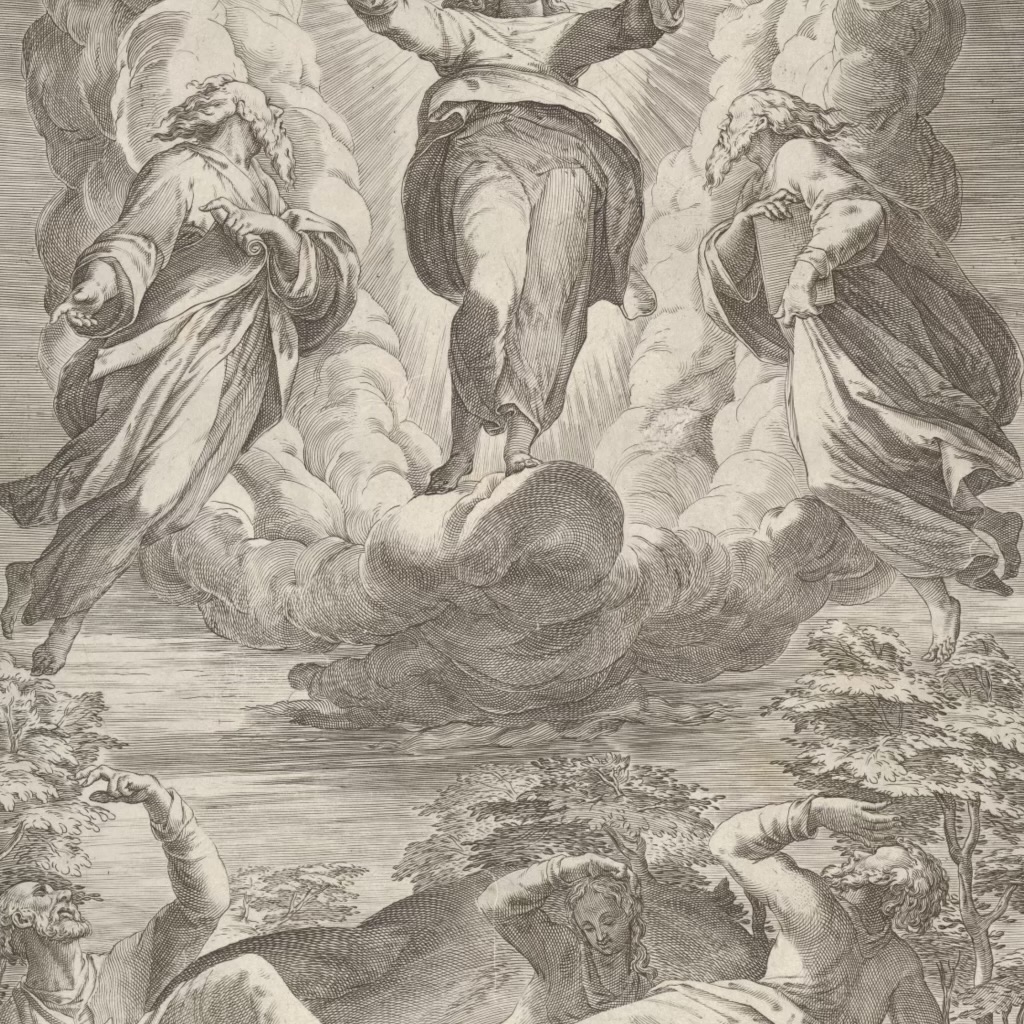
An excerpt from a forthcoming study.
The overarching theme in Matthew of Jesus as a type of “new Moses” has long been recognized by scholar and layperson alike, and its grip was tightened with the release of Dale C. Allison’s landmark volume The New Moses: A Matthean Typology.[1] Allison’s rather consolidating yet independently and equally stimulating work, following its publication, quickly found its place as not only a reference work belonging on most shelves, but also in countless scholarly footnotes endorsing it. To this day his work is almost ubiquitously and unanimously championed, though it has had its dissenters.[2] Along with countless, increasing year-by-year, other scholars, Allison recognizes in Matthew (and elsewhere, as well) the metatrope of Jesus being illustrated as a “new,” “better,” or “additional” Mosaic figure.[3] These arguments are primarily sustained at their basal level via Moses’s prophecy in Deut. 18:15–19 of another Prophet coming after him “like” him; yet, they rely not on this reference alone, but multiple literary devices and techniques as well as other imagery, motifs, symbols, and literary gestures which corroborate the Mosaic image. First, we must look at the reference in Deuteronomy and its significance.
15 The Lord your God will raise up for you a prophet like me from within your midst, from your brothers—to Him you shall listen. 16 This is in accord with all that which you desired from The Lord your God at Horeb, on the day of the assembly, when you said, “Let me not hear the Voice of The Lord our God any more, nor let me see this great fire any longer, lest I die.” 17 And The Lord said to me, “They are right in what they have spoken. 18 I will raise up for them a prophet like you from among their brothers, and I will put My Words in His mouth, and He shall speak to them all that which I will command Him. 19 And it shall be that whoever listens not unto My Words, which He speaks in My Name, I will hold it to them.”[4]
The figure explained above is indeed cast in the mold of Moses yet seems to be presented as a supersession of him.[5] This prophet will be “like” (כָּמ֑וֹךָ) Moses, but the formulation is eschatological in nature and Mosaic in function: He will come from within the midst of Israel, one of their own (v. 15, 18), at an unbeknownst future time,[6] and He shall be listened to (v. 15, 19a) as if God Himself (v. 19c), being given the very Words of God and commanded to proclaim them (v. 18 b–c, 19b).[7] The patterning to Moses and Israel is similar here in God speaking to them through a mediator, given their refusal to continue to hear God’s Voice at Sinai.[8] Much like the notorious difficulties surrounding the servants of the Great Poem of Isaiah (Isa. 40–55),[9] there is likely more than singular expectancy in the passage. Richard Nelson observes, “In spite of the literal singularity of ‘a prophet’ (v. 15, note k), it seems obvious that a series of prophets is meant (cf. 17:14–15, where more than one king is undeniably in view).”[10] Likewise, Peter Craigie writes that the singular “prophet” is a “collective form indicating a succession of prophets.”[11] These observations accord nicely with the context, too. As Duane Christensen points out,
The focus of attention in this structure is on the fact that the true prophet is the one who speaks all that YHWH commands him to say (v. 18d). The inner frame highlights that it is God’s own words that the true prophet is commanded to communicate: God puts his words in the prophet’s mouth (v. 18bc); and those who refuse to obey those words will be held accountable (v. 19). The outer frame presents the contrast between the true prophet like Moses (vv. 17–18a) and false prophets, who speak presumptuous words in YHWH’s name that he has not commanded them to say, or speak “in the name of another god” (v 20).[12]
That Deut. 18:15–19 has in mind prophets rather than just a prophet does fit nicely within the general tenor and context of its surrounding passages.[13] Yet it does not follow that the application to Jesus is unwarranted, though it is prudent that “We must rule out any inherent messianism in the present verse, even though Jesus was seen in the early church as being the ‘prophet like Moses’ (Acts 3:18–24).”[14] To dismiss possible connections by the later Church on the grounds of plural “prophets” in view here betrays a fundamental misunderstanding of prophecy, typology, and interpretive hermeneutics employed in EC and STP Judaism.[15] As discussed above, GM conceives of Jesus’s “fulfillment formulae” in more conceptual and eccentric ways, not unlike his allegory-loving fellow STP Jews.[16] Such measures are not necessary—that is, dismissing the grounds upon which many see in Deut. 18’s “a prophet like (or, greater than) Moses” foresight of Christ—but, rather, what emerges is an image which dovetails with similar proposals of Jesus’s Mosaic comparisons, and we may offer a richer integration of multiple themes at play.
Hindrances to additional insights into the form and function of Jesus’s Mosaic references in Matthew, and elsewhere, could be subsumed under the category of scholars and readers overemphasizing the notion of “prophecy.” Though Jesus is undoubtedly placed as a prophet—and the prophet, par excellence—in EC,[17] interpreters routinely overlook what ideas of a “prophet” and “prophecy” would denote in STP Judaism;[18] namely, the primary focus on the Torah and its interpretation.[19] In taking together Hindy Najman’s Seconding Sinai,[20] David N. DeJong’s A Prophet Like Moses (Deut 18:15, 18),[21] and the recent work by Levi S. Baker, Why a “New Testament”?,[22] we may more readily identify at least one of the cruxes of Matthew’s Mosaic portrayal of Jesus. Both DeJong and Baker interact significantly with Najman; Baker mentions DeJong in passing;[23] and, published in 2025, Baker’s work postdates the former two. Thus, we may sequentially compile the theses of each author’s work and how they contribute to one another.
In Seconding Sinai, Najman offers a methodological (re)consideration regarding the nature and intent of STP pseudepigrapha through a larger concept she terms as “Mosaic Discourse.”[24] Through a revisionist reading of Deuteronomy,[25] to which we will return below via DeJong, and a reconstructionist reading of STP texts like Jubilees, 11QTemple, and Philo,[26] Najman forcefully argues against notions of plagiarism and corruption held by many with regard to the creation and reception of pseudepigraphical sources. Instead, Najman identifies in these texts appeal to the authority of the figure Moses as a “model” which justifies their existence and any authority they claim. These works rework, expand, and supplement Torah while claiming authority via special or individual revelation, or by claiming authorship by Moses.[27] Najman’s elaborations on these various points are hard to pin down, given that she is both (a) particularly careful to avoid any specific anachronisms or generalizations within, between, or without the works she analyzes, and (b) in her work she seems mostly occupied with cultivating discussion rather than actually advocating any particular view. These implications for discussion emerge in later works.[28]
In A Prophet Like Moses, DeJong offers what can only be considered an incomparable study which auspiciously fills an unsuspected lacuna in biblical research. Several features of DeJong’s work stand out, however. For one, DeJong believes that most of EC’s identification of Jesus as the prophet like Moses is most prominent in the Gospel of John and in Luke-Acts, contra many who would argue to the contrary, especially when Matthew is in view. “Matthew’s gospel is perhaps the most prominent example of an early Christi-an text that draws heavily upon Moses typology,” he writes, “but makes little explicit use of Deut 18:15.”[29] In his appended footnote, DeJong cites David E. Aune’s comments[30] that “although Matthew uses a number of literary devices and theological motifs to depict Jesus as a new Moses, he never attempts to identify Jesus with the eschatological Mosaic prophet,”[31] as well as Allison’s insistence[32] that “Moses-typology is broader than just interaction with this text.” He ultimately concludes that, despite the author’s intention, “such a conclusion can only remain speculative.”[33] This is a fair assessment, but as I will argue below, DeJong’s own thesis—or, at the very least, the logical and natural implications of it—betrays his comments here. However, it is important to point out—and much more important a point than one tucked away into a footnote—that our author consciously acknowledges that his work “could or perhaps should” have included Matthew, thus we are unaware of any evidence DeJong may have unearthed in a committed analysis[34] if he had taken a closer look at Matthew and employed his methodologies.
DeJong describes his work as taking up “Najman’s call to study ‘other developments’ of Mosaic Discourse,”[35] which he seems as extending beyond the “narrow” features that she ascribes to Mosaic Discourse (MD) and her limiting of analyses to work envisaged as “imitations” of Mosaic literature. For DeJong, these views are not aligned with “the model that Deuteronomy itself actually establishes for linking later authoritative discourse to that of Moses” and, as such, MD is under no compulsion to legitimize itself by either an appeal to Moses or Sinai.[36] Instead, MD is more expansive and relevant literature may be considered within its stream as set against the model and standard for prophecy; that is, Moses himself. He writes, “To focus on Moses as a standard is to examine the way the category of a prophet like Moses is invoked as a criterion of authentic prophecy.”[37]
To demonstrate his enlarging thesis, DeJong identifies Moses as being identified with the stream of prophets (17–29), how Deuteronomy defines Moses and prophecy (30–71) and the Mosaic Prophetic Succession in Deuteronomy (72–96), Jeremiah (97–122), and, finally, eschatological notions in Deut. 34:9–12 (123–142). As DeJong claims, “The prophet is not a charismatic wonder-worker, but legislator and oracular guide,” though one does find that the idea of a “prophet” (cf. Hos. 12:13–14) “is associated with the Exodus tradition,” identifying for us that “The operative model of prophecy therefore is that of a charismatic savior figure.”[38] The singular prophet (as discussed above) in Deut 18 “is distributive: the passage promises not one particular prophet or even one succession of prophets; it authorizes an institution of prophecy”[39] which establishes that “The prophet is the only legitimate conduit of divine revelation, which is for Deuteronomy is funda-mentally a matter of speech,” and specifically the “passing on the words of Yhwh.”[40]
The thesis is thus that the prophet like Moses in Deut. 18:15–19 establishes for Israel a paradigmatic model of future revelation and mediation in the archetypal Moses. As we will argue below, Jesus is constructed in the image of the prophetic heritage here not only in His speaking authoritatively for God, but in His mediatorial role as well: the two inter-linking concepts of teaching and deliverance coalesce upon the Person of Christ, and this is aligned with the larger theme present in Deuteronomy. Moreover, Jesus enhances what Deuteronomy anticipates and inaugurates in this conciliatory role by being presented as the medium of direct revelation from God.
Three ideas converge here from DeJong’s work. The first is that the concession which establishes this prophetic heritage and model is cast in a positive light. When reading the passage of Deut. 18:15–19 in context, it follows the prohibition of divination and other forbidden practices (vv. 9–14), but specifically that the nations listen to these sources (v. 14a). Israel, however, is not allowed to practice such things (v. 14b). Instead, they will be provided with this “prophet” to guide them; this office of inspired and authorized mediation which is placed in strong juxtaposition to that of divining sources and is established as a concession to Israel’s refusal to continue to hear the Voice of God at Sinai. They still, however, need continuous guidance. DeJong comments, “One might suggest, then, that Deuteronomy’s explicit attestation of divine approval of the people’s request is then a significant hermeneutical marker. The successive appointments—first of Moses and then of the prophets like him—as mediators to speak on God’s behalf constitute a legal revision to address the people’s ongoing need for a source of authorized revelation,”[41] which establishes the second idea. In Deut. 18, God initiates a program of prophetic succession for Israel’s mediated guidance from God in the model of Moses as set against their refusal to hear the Voice of God at Sinai: someone will stand between Israel and God, but God will indeed provide them with continued revelation, and indeed He approves this.
The third, which does rely partly on source and form criticism as identifying the editorial work of Deuteronomy, point is that Deut. 34:10’s “denial that a prophet like Moses has arisen provides an opening for an eschatological interpretation of Deut 18:15, 18.”[42] To substantiate this, DeJong argues that “Deut 34:10 is both dependent on and a qualification of the promise of a prophet like Moses,” not only because these two texts remain the sole passages that “explicitly designate Moses as a ‘prophet,’” nor solely given the use here of the uncommon “prophet” and “arise” language in comparison to Moses, but also because “in Deut 18:15, 18, Moses and Yhwh unambiguously affirm the possibility and the future coming of such a prophet.”[43] For many, DeJong’s argument via that of form and source criticism—seeing Deuteronomy as the (final) result of later editorial work by scribes—is unwelcomed, but his arguments may be evinced without such imposed views onto the text, and an origin from inspiration essentially makes the same points. For him, via interacting with scholarly discussions over the purpose of redaction in Deut. 34 with the effect of creating Mosaic canonicity, DeJong offers a view emphasizing a chronological rather than canonical view. A summary of some length is probably helpful.
These are thus two scholarly traditions that can be traced: some interpret the passage as that which separates Moses from the prophets and establishes the Pentateuch as normative… others emphasize the way this conclusion joins the law and the prophets…What unifies these proposals, however, is the view that Deut 34:10–12 is framed particularly with reference to textual corpora, though they differ on the details of which texts are in view. In contrast to all these proposals, I would argue that the editors have a chronological, and not a canonical, division in view here: Moses, the preeminent “servant of Yhwh,” is separated from his prophetic successors…the “prophets” in view are not to be understood in the first place as prophetic scriptures, but as all the historical prophets who arose in Israel between Moses and the post-exilic situation of the framers of the Pentateuch. Deuteronomy 34:10–12 participates in a historiographic project, and further refines the periodization of prophecy begun by the creation of the class of “servants of Yhwh” in the DH. It refines this by creating two distinct prophetic eras: Mosaic prophecy, which is supreme, and post-Mosaic prophecy, which includes all of Moses’ inferior prophetic successors… in its immediate context, the insistence that no prophet like Moses has arisen in Deut 34:10–12 occurs as a comment on Joshua’s accession to leadership within Deuteronomy (Deut 34:9). This is strong evidence for a chronological rather than canonical interpretation of the import of Deuteronomy’s concluding denial of parity between Moses and the prophets.[44]
Providing an extended summary of DeJong’s view is helpful for our purposes, though I would argue there could, and perhaps should, be an element of “an incipient notion of a bipartite scriptural collection, an antecedent to ‘the law and the prophets’”[45] that other scholars variously envision. In other words, Deut. 34:10–12 has a canonical essence to it while primarily being chronological, demonstrating a successive prophetic line following that of Moses. DeJong’s comment here that Deut. 34:10 itself is “a comment on Joshua’s accession” is important, as he outlines several important nuances in the text. The first is that Deut. 34 describes the death of Moses and closes out the book. It is important, then, that in 34:9 Joshua is described as “full of the spirit of wisdom” (v. 9a), due to Moses having placed his hands on him (v. 9b), and that the Israelites listened to him (v. 9c). What follows in v. 10 is, thus, a direct response to the mention of Joshua by way of comparison yet continuity. Joshua, therefore, is placed in some sense as the prophet of Deut. 18:15, though in a limited capacity, yet commissioned by Moses himself. The Israelite’s obeying him “indicate their willingness to continue to receive divine instruction via an authorized mediator” and “the promise of a prophet like Moses therefore receives an initial fulfillment within the narrative arc of Deuteronomy itself.”[46]
Secondly, DeJong calls to view the fact that Joshua remains the only character within the biblical narrative that receives the specific title of “servant of the Lord,” precisely with the inclusion of the Divine Name. Marked significance, in my mind, is that Joshua being called the servant of the Lord is found only recorded alongside his death (Jos. 24:29; Jdg. 2:8), which both (a) mirrors the same designations applied to Moses’s death in Deut. 34 and the transition into the Book of Joshua (1:1, 2, 7, 13, 15) and (b), as I will argue, serves as a significant marker of the mortality of God’s prophetic mediators in contrast to Jesus. As has long been pointed out by laypersons, yet curiously neglected by scholars, I would argue that the designation “servant,” though certainly creating an intertextual, theological vocabulary with Isaiah to be applied to Christ,[47] pales in comparison to the import of the name Joshua for Christological purposes. That Deut. 34:10—and the biblical narrative as a whole—has a man named “Joshua” following after Moses in succession creates a typological model furnished for the coming of Jesus, sharing the same name.[48] Joshua, this type, leading Israel into the Promised Land also holds a wealth of significance when it is applied to Christ and the exodus-themed and shaped salvation found in Him.[49]
Third, similar to the implications made above, for DeJong there remains rather stark comparison between Joshua (and, later, Jeremiah) and Moses in 34:10 that naturally and deliberately invokes 18:15–19. Not in the sense of limiting or prohibiting further prophetic characters to arise after Moses, but referring “to the endogenous qualification of the prophet in 18:15, 18” and having the goal “of establishing the Mosaic age as the definitive era of revelation.”[50] DeJong identifies three “features of Moses’s career” which bifurcate him from others: (1) his speaking to (and knowing) God face to face, a unique feature of Moses’s life made known in Exod. 33:11 but emphasized in Num. 12:6–8, (2) his ability to work and be used to work “signs and wonders” and, relatedly, (3) his role in the Exodus narrative, performing actions directly for (and, to some extent, in place of the agency of) God.[51] In light of the future prophetic programs in Israel by God’s prophet servants the passage “divides the Mosaic era from this history as a special and normative epoch by insisting on Moses’s incomparability” and gives rise to eschatological exegesis given the fact that “if a prophet like Moses has not yet arisen, then the specific promise of Deut 18:15, 18 that a prophet like Moses will arise remains unfulfilled.”[52] Deut. 34:10 therefore can be seen as creating an “open-ended and incomplete character of the narrative”[53] and the “chapter as a whole emphasizes that the story is not complete.”[54]
These typological yet literal features prepare the way for Christ’s presentation in the Gospels beyond the, as many could claim, superficial similarity of the name “Jesus.” First is the emphasis on Jesus’s miracles embedded into the very narratives of Matthew, Mark, Luke and John.[55] Second is the theme of exodus-shaped deliverance that Jesus provides for believers in salvation[56] and the employment of this theme in His earthly ministry.[57] Third is the consistent presentation of Jesus’s intimacy and direct relationship with God in the Gospels.[58] DeJong’s earlier focus on Joshua being filled with the spirit of wisdom, and the “passing of the baton” from Moses to Joshua (my point), accords with the Spirit descending upon Jesus at His Baptism in Matthew 3 as well as the Spirit’s unique involvement in His life to that point.[59] The continued successor theme with Moses and Joshua is aptly applied to John the Immerser and Jesus, not only due to John’s own comparison to Elijah and Isaiah 40:3,[60] but other symbolism which surrounds the narrative invoking the Exodus.[61] Though GM may be implicit, at best, in using the theme of Moses having had a face to face relationship with God,[62] the device is employed explicitly in the Gospel of John 1:17–18[63] and may reflect a shared tradition between the Gospels, as some have argued.[64]Nevertheless, Matthew unambiguously links Jesus to the Isaianic Servant (e.g. Matt. 12:18),[65] which can be traced back to Moses as “servant,” and therefore one could argue to “prophet,”[66] especially since Jesus ascribes to Himself, at least by allusion, the description of a rejected prophet in Matt. 13:57 (cf. Deut. 18:19). In the context of Him being rejected at Nazareth, the qualifications of Deut. 18’s prophet—sent to Israel; from among Israel; from Israelite descent; not to be rejected—would be glaring in the setting of Jesus’s own hometown. Another powerful suggestion that Jesus is being presented as the eschatological Prophet-Servant is the Transfiguration (Matt. 17:1–13) which has not only Moses at Jesus’s side, but also Elijah, prophet par excellence next to Moses.[67]
As a webbing of literary devices, GM can easily be recognized as filling out the various features ascribed to and identified with Moses not only generally, as we have already gone over in the previous section, but specifically, with respect to the prophet like Moses. This does not have to be intentional, as DeJong denies, but is nevertheless more than apparent in Jesus’s presentation, even if merely the consequence of similar, associated, and overlapping ideas in STP Judaism. This type of device-linking exegesis—what he calls “the representation of Moses as a literary device whereby narrative elements are designed to recall the life of Moses”[68]—is that which DeJong explicitly as the focus of his study in its early pages. This “exegesis” focuses on Moses as a type, while DeJong’s study focuses on Moses as a standard; a standard whereby one may “examine the way the category of a prophet like Moses is invoked as a criterion of authentic prophecy in Second Temple Judaism and nascent Christianity.”[69] I would contend that DeJong’s arguments undergird the nature of Jesus’s Mosaic comparisons in both type and standard, and especially when taking in-to account the work of Baker (below) coupled with an argument set forth by DeJong we have not yet covered.
In chapter two of his work, where DeJong attempts to trace the redefinition of Moses and of prophecy in Deuteronomy, he identifies resonances of the Law within the editors’ activity drawing from Israel’s legal traditions: “Deuteronomy presents itself as a law-code that attempts to establish the community on the word of God, which it insists is accessible to Israel and available to be obeyed,” indeed, and this is placed in stark antithesis to the nations and their divinatory practices.[70] However, “within the law-code itself, Deuteronomy includes provision for one authorized source of further revelation, namely the prophet like Moses” which is “justified by an etiological narrative” in 18:16–18,[71] and this is where DeJong provides for us some insight into Jesus’s “prophet like Moses” role: since the prophetic role of Moses is directly involved with promulgating Law, this is a possible identifier to be associated with Christ, and place Him squarely in this role. DeJong writes that, given Moses allows for future revelation within this legal etiology,
It follows from this that Deuteronomy’s designation of Moses as a נביא [prophet] is integrally bound up with the book’s self-consciousness of its idiosyncratic character vis-à-vis other Pentateuchal law. While the rest of the Pentateuch ordinarily has God speaking the law to Moses; here in Deuteronomy Moses speaks the law to Israel. By the vehicle of Mosaic Discourse Deuteronomy reveals itself to be hermeneutically self-conscious: the book’s writers are keenly aware that they are presenting an updated interpretation of the “Mosaic” law for a new era, and they draw their portrait of Moses accordingly. At every stage in the book’s composition, Moses is interpreted as a teacher (see למד in Deut 4:1, 5, 14; 5:31; 6:1; 31:19, 22) and interpreter of the law: he expounds Torah (see באר in Deut 1:5; 27:8). Deuteronomy thus has a homiletic and hortatory character.[72]
By being acutely aware of the legal connotations and nuances within the text, DeJong is arguing that Deuteronomy presents Moses “as an authorized interpreter of God’s Word” and, via the prophet like him in 18:15, 18, “authorizes ongoing legal revision to the mosaic tradition.”[73] As we will see, this specific view primes Matthew’s presentation of Jesus and what we find Him doing within GM, locating Him as precisely fulfilling the prophet like Moses in form, function, and future expectations outlined in the stream of prophetic succession itself, establishing a future character to follow and exceed Moses.
In Why a “New Testament”?, Levi S. Baker asks and provides a sound exegetical investigation into the impetus of the NT Scriptures, which he argues is partly, at least, the idea of “covenant,” and precisely a new covenant which warrants these writings. Baker avoids focusing on the topic of canonicity, and specifically canonical writing in EC, but he does not avoid discussing the topic(s) in detail.[74] The thesis Baker proposes is narrower than that of Najman and DeJong, though the manner in which he argues involves numerous points of data and clarifications over relevant points of contact. For him, a pattern which can be readily and consistently identified throughout the Hebrew Bible (HB) is that of a covenant → covenant document theme. After examining the significance and meanings of “covenant” in the HB, and the paradigmatic nature of the Mosaic covenant in comparison to the others (a point he develops throughout the work),[75] Baker examines what he sees as a formative pattern in Exodus with the Ten Words, the Covenant Code, and their relationship.[76] His argument then begins to take shape as he looks at Exod. 34; Deut. 29 and 30; Jos. 24; 2 Kgs. 23:1–3; and Neh. 8–10—all identified as events resembling a type of covenant renewal, and particularly that of renewing the Mosaic covenant. In Exodus 34 new material—“not merely restated or recycled [material] from Exodus 20–23,”[77]— is provided to Moses and “the new covenant document that Moses writes in v. 27 stands in a similar summary/expansion relationship to the Decalogue as does the CC [Covenant Code; Exod. 21–23].”[78] For Baker, Covenant → Decalogue → Covenant Code → [covenant renewal] → New Decalogue → New Material in Exodus establishes a pattern that can be applied in later covenant renewals; the adjoining of new documents.
In Deuteronomy, Baker sees an oral-and-written narrative that is fundamentally covenantal—not quite a covenant renewal per se, but a supplemental covenant “beside” the Sinai/Horeb covenant.[79] Much can be made of this, and no frictionless position is likely to be made given the accretion of scholarly views surrounding the myriad of particulars involved here. Baker’s proposals are simple: equivalent to the covenantal renewal pattern in Exodus, Deuteronomy presents itself in a way that includes new material and the writing of additional (or supplemental) documents commensurate to previous violations of the covenant and new circumstances which necessitate (or invite) further stipulations.[80] In Joshua 24, Baker recognizes continuative covenant-renewal documents (e.g. 24:25–26) and its addition to “the Book of the Law,” which refers to the written form of Deuteronomy.[81] Though 2 Kings 23 lacks the adding of any covenantal documents, the discovery of the Book of the Law and the subsequent covenant renewal → document reading → sacrifices and communal meal—a ritual theme Baker posits as accompanying the covenant renewals[82]—positions the pericope as corelative to other events. The same can be said of Nehemiah 8–10 and his treatment of it, though additional stipulations, as well as commentary on the text, is inherent to the reception and ceremonies surrounding the covenant renewal in Ezra and Nehemiah.[83] Finally, Baker looks at Jeremiah 31 and what is described as the internalized[84] new covenant there, though conjecturing over the possibility of new instructions (i.e., “laws”) accompanying the covenant.[85] Providing a summary of his analysis of the previous five sections of Scripture, Baker writes,
In every covenant renewal except the Josianic covenant, each time a covenant is cut to keep the existing covenant, the received covenant document is retained and further supplemented with new covenant stipulations outlining the expected loyalty in the present situation. In the words of Wellum and Gentry, “[I]t seems that the renewed commitment becomes part of the declaration in the original covenant, like a codicil added to a will.”[86]
Baker adds in the concluding sections of his core chapter a connection between what he considers the “larger environment of revelation expectation” and the related correspondence between Deut. 18:15–19 and later passages, writing that Deut. 18 “was occasionally read as promising an eschatological prophet that would bring new revelation.”[87]
This revelation has an explicit covenantal context since Deut 18:16 immediately relates this prophet’s role to Moses’s role of mediating the Sinai covenant’s stipulations. The prophet Moses contributes to the background of the Servant in Isaiah, and Isa 59:21 appears to apply Deut 18:18 (“my words in his mouth”) to the Servant, through whom God will bring a new covenant. Yahweh makes a covenant with his people to put his words in the mouth of his Servant, who himself is and delivers the covenant and brings revelation (Isa 42:6, 8; 46:6, 8). Thus, the appearance of the new divine, covenantal, revelation mediated through the new Moses is part of the very content of the promised new covenant in Isaiah.[88]
We will augment these various connections below, but the direct association is helpfully instilled in our minds. What follows in Baker’s work is the adjoining of covenant documents to covenants in the STP which traces “the reception of the HB in whole or part as a covenant document” onto the observation that “some [STP] Jewish works were amendable to or claimed to be new scriptures in a manner that was connected to the notion of covenant.”[89] While the evidence is not as pervasive in STP literature, the community and literature behind the DSS, in contrast, “began to receive their own writings as new covenantal revelation.”[90] To this point, Baker locates the cognitive cradle in STP Judaism from which EC would intrinsically anticipate new covenant documents adjoined to the ushering in of a new covenant through Jesus. Given the close association between covenant in the HB and covenant documents, “Early Christians who observed this pattern and believed that Jesus had inaugurated the new covenant would have naturally expected new scriptures.”[91] In other words, “the connection between covenant and scripture was part of the theological soil of [STP] Judaism(s) in which early Christianity took root.”[92]
Here Baker turns his attention to Matthew, and to that which concerns our interests. Though Baker probes both James and Hebrews in his analysis of new covenant documents in the NT,[93] as well as the perception of new scripture in second century EC,[94] our focus is on his exegesis and overview of GM which may supplement our own attempt for analyzing it. For Baker, GM unambiguously presents Jesus as the Greater Moses through “the fivefold collection of Jesus’s teachings, the Jesus-on the-mountain theme, [sic] and its portrayal of Jesus as teacher.”[95] These three points, while potentially regarded as moderate ties to the prophet like Moses, can be argued as deliberate attempts on Matthew’s part to present Jesus in a Mosaic form which would holistically invoke the idea. As Baker writes, “Matthew presents Jesus’s teaching in five collections, each ending with the expression ‘When Jesus had finished,’ followed by a reference to his teaching, instruction, or speaking.” Though admitting that “its significance is debated,” Baker argues it highlights Jesus as a teacher but “considered alongside other features in Matthew, it appears to echo the five books of Moses,” which would seem difficult to dismiss.[96]
An example of Moses as a type for Jesus in DeJong’s work is the “story of baby Jesus’ nearly fatal end at the hands of an evil king, which recalls Exodus 1–2,”[97] but one would recognize this as part of a larger Mosaic mosaic (!) in Matthew’s presentation of Jesus. As Baker points out, this reference is indeed important but part of a larger program that can be expanded beyond a mere passing of several details comparable to Moses: “the angel’s words to Joseph in Matt 2:20 are a quotation of Exod 4:19. Like Moses, Jesus undergoes an exodus from Egypt (Matt 2:13–15) and fasts forty days and forty nights”[98] and Baker points out, too, the significance of the Transfiguration—“which evokes Moses’s Sinai experience via details that include a ‘high mountain’ setting, a cloud’s descent, a voice from a cloud, the main character’s radiance, onlookers’ fearful response, a special group of three, and a six-day period”[99]—and that “the command to ‘listen to him’ (Matt 17:5: ἀκούετε αὐτοῦ [sic]) echoes the charge to ‘listen to’ (Deut 18:15: αὐτοῦ ἀκούσεσθε) the prophet like Moses.”[100] These, and other details, reveal an intentional Matthean attempt to aptly and unassailably present Jesus as the prophet like Moses, moving the comparison beyond the “speculative” even if no explicit mention is made by the author—a qualification that is by no means necessary or even warranted. It is curious why a comparison to Moses on a macro-level would preclude a comparison to the prophet like him on a micro-level. We would most naturally associate the latter as subsumed under the category of the former, and for Jesus to be presented as Moses in general would holistically invoke the eschatological prophet like Moses. Any tension between the two seems forced.
Further significance is showcased by Baker, particularly that of the use of mountain-geography, a theme that indeed recalls Mount Sinai and Moses’s ascent of it—as has been explored by many scholars[101]—but is itself dependent on a much more expansive domain of symbolism within the HB. Not only would Jesus’s mountainous events in the Gospels evoke the Exodus—especially when combined with other geographical features frequently employed like the sea, wilderness, and feeding accounts[102]—but it would, additionally and perhaps more profoundly, evince eschatological associations with divine revelation more generally and Mount Zion more specifically.[103] Baker briefly acknowledges most of these details, but does not expound upon the connection here between the mountainous language in Matthew and the cosmic Mount Zion in Isaiah 2:3, though he does mention it and the “eschatological proliferation of the law.”[104] Taking a brief look at the reference in Isaiah reveals a parallel that should not lay dormant in analyzing GM.
And it shall come to pass, in the latter days, that the Mountain of the House of the Lord shall be established: it will be the head of the mountains, exalted above the hills, and all the nations shall flow to it. And many people will come, and they will say, “Let us go up to the Mountain of the Lord, to the House of the God of Jacob; He will teach us His ways, and we shall walk in His paths, for out of Zion shall go forth Torah, and the Word of the Lord from Jerusalem. (Isa. 2:2–3; author’s translation)
The Torah (i.e. “Law”) coming from Zion is also found in Micah 4:2[105] and, fixed against the eschatological mountain, the significance is difficult to overstate, though the topic as a whole is beyond our present scope.[106] As the Isaian Servant, Jesus’s teaching role, which is illustrated significantly in GM,[107] would present Him not only as bringing forth Torah from Zion to the nations but other passages such as the coastlands waiting for His Torah (Isa. 42:4) and God magnifying the Law (Isa. 42:21) and Jesus’s itinerant ministry within the Galilee can be seen as the fulfillment of the Great Light in Galilee (Isa. 9:1–2).[108] The themes here naturally lead beyond the prophet-like-Moses and Isaian-Servant and begin to present Jesus as God—as Immanuel, translated, “God with us” (cf. Isa. 7:14). It would be far beyond our scope or aims to delve into the Christology of Matthew’s Gospel or to the Christology of any Gospel,[109] but the conformity of the Matthean Jesus and His teaching actions (as we will develop in this essay) to Isaiah naturally leads to Isa. 54:13, which reads that “And all your children will be taught by the Lord, and your children will have abundant shalom.”[110] Jesus’s teaching activity, it can be argued, is not only set against the background of the prophet like Moses, but as the Lord Himself.[111]
Gathering together the multifarious and interlocking motifs applied to or describing Jesus in Matthew, what surfaces from this sea of intertextual and eschatological characterizations of Christ is nothing short of God Himself with Israel, fulfilling their messianic expectations which included being taught the Law of God in its fullness and truest sense. Baker emphasizes this in his treatment of the SM,[112] which we will delay interacting with, given our own is to follow, but what he sees is an aspect of “New Covenant Torah” being promulgated by Jesus in the SM, thus furthering the progressive and unfolding ushering in of a new covenant by Jesus accompanied by supplementary and further instruction in similitude to HB patterns; covenant renewal → covenant documents.[113]
Given the structure of Matthew into five “speech sections” which mirror the fivefold structure of the Pentateuch, the conscious associations with the prophet like Moses both in form and function, type and standard, and the authoritative documentation of Jesus’s words and commandments for the inauguration of the new covenant (cf. Jer. 31:31–33) we may regard GM as new covenant scripture. This view is enhanced by the observation that Matthew designates his gospel in 1:1 as βίβλος γενέσεως ᾿Ιησοῦ Χριστοῦ υἱοῦ Δαυΐδ, υἱοῦ ᾿Αβραάμ, which Baker argues echoes Gen 2:4; 5:1, is decisively used as a title for the whole Gospel rather than Matthew 1, and indicates that Matthew presents his Gospel as “a new scriptural story, a new Torah in connection with Jesus,” adding that “It is difficult to escape the title’s implicit scriptural claim.”[114]
While the focus of our article remains on Matthew 5–7 and the SM, we can that it is set against a larger canvas from which the themes and motifs thereof become more pronounced in the SM: it is the crescendo and pinnacle of Matthew’s Mosaic mosaic (!) of the eschatological prophet not merely like Moses, but greater than Moses; not in any denigrating or supersessionist manner, but rather in Christ being the telos of the succession of prophets. He is the realized anticipation and eschatological unveiling of the prophet like Moses in that Israel now hears directly from God, and receives their deliverance—indeed the Second Exodus—that the story of the first looked to (cf. 2 Cor. 3; 1 Cor. 10:1–7). In Christ the new covenant of Ezekiel 36–37 and Jeremiah 31–33 is realized, and maybe it is the much more excellent ([νυνὶ δὲ] διαφορωτέρας, Heb. 8:6) nature of the covenant that He brings, and its instruction, which prevents the Gospels—if we are convinced that the presentations are insufficient and yet implicit—from making the direct comparison. For them, Deut. 18:15–19 legitimized the succession of prophets and the office of mediated revelation, and Deut. 34:10–12 ensured that an eschatological role would remain, an office of no comparison, that only Christ could fill.
Drawing together Najman’s Mosaic Discourse, DeJong’s various findings, as well as Baker’s proposals, we may articulate the qualifications for Jesus’s presentation as not just the prophet like Moses but the eschatological Servant figure that brings Torah from Zion and not only speaks for God, but is equated with God speaking directly. The plethora of characteristics and qualifiers of the prophet like Moses and continued Mosaic Discourse coalesce upon the Person of Christ, but in Him the concepts are magnified—the gulf of communication between Israel and God via the (requested) mediation of Moses and the prophets to follow him is closed in Christ, and it is all the likely that God’s positive view towards this request (cf. Deut. 18:16–17) is due to the plan to reveal Himself fully in the coming of Christ. The very texture of Matthew’s narrative resembles the jagged cliffs and contours of Sinai, its story shadowing Exodian geography, casting Israel as going through the wilderness, led by their prophet like Moses, Immanuel.
[This excerpt reflects a precursory treatment to the Sermon on the Mount, therefore being explained by the findings presented therein. As I will argue, Jesus is presented in the Gospel of Matthew as one who is elucidating the Law in its original intentions and operating within the realm of divine instruction.]
[1] Dale C. Allison Jr., The New Moses: A Matthean Typology (Minneapolis: Fortress Press, 1993). Arguably, B. W. Bacon was (one of) the first to propose a Mosaic typology in Matthew in his article “The ‘Five Books’ of Matthew Against the Jews,” Expositor 15.8 (1918): 56–66. Therein he is also counted amongst the first to propose the five-fold division of Matthew mirroring the Pentateuch. W. D. Davies, in his monumental work The Setting of the Sermon on the Mount (Cambridge: Cambridge University Press, 1976), is often regarded as the first to mount a direct and exhaustive appeal to the typology, as well as numerous five-fold themes.
[2] Famously, John P. Meier has challenged this view, and Allison’s views specifically (A Marginal Jew: Rethinking the Historical Jesus, AYBRL. 4 vols. [New Haven, CT: Yale University Press, 1991–2009]). Few question the use of the various motifs, however, yet primarily deliberate upon the intended aim in their use.
[3] Geza Vermes (Jesus the Jew: A Historian’s Reading of the Gospels [Minneapolis: Fortress Press, 1973], 94) identifies an eschatological prophet as a prevalent expectation in STP Judaism, and recognizes this from a particularly historical-critical approach. Allison’s views have mostly gone unchallenged, and what follows will present many of the reasons why the conclusion is not difficult to come to. For a purview throughout interpretations of Moses in the era of EC, see Philip Rousseau and Janet A. Timbie, eds., The Chistian Moses: From Philo to the Qur’an, SEC (Washington, D.C.: The Catholic University of America Press, 2019).
[4] Author’s translation. For discussion on aspects of translating the passage, see cited sources listed below.
[5] By naturally taking supersession in its gentlest form. The prophet is regarded as following after Moses, and therefore is expected to continue Moses’s own ministry but also to enhance it, given the anticipation of even the land is in view. We will develop our ideas below, but for now the text indeed suggests to us a fuller function and purpose of this prophet, as he is to be given direct communication and agency with God, like Moses but implicitly to a greater degree. For a brief yet concise overview of sounder approaches to supersessionism, see Daniel Boyarin, “The Subversion of the Jews: Moses’s Veil and the Hermeneutics of Supersession,” Pages 184–210 in idem., Sparks of the Logos: Essays in Rabbinic Hermeneutics, BRLJ 11 (Leiden: Brill, 2003). See also Ralph J. Korner, “Post-Supersessionism: Introduction, Terminology, Theology,” Religions 13.2 (2022): 1195, for an introduction and overview to post-supersessionist hermeneutics in academia.
[6] The Lord will “raise up” (יָקִ֥ים), with the Hiphil imperfect, and Israel “shall listen” to him (תִּשְׁמָעֽוּן), the Qal imperfect. A future action is clearly in mind, though it remaining unrealized in Israel’s history must be realized on a basis beyond the grammar. See our discussions below.
[7] The theme of being given the Words and commands of God is scatted throughout the HB, marking the set-apart authority of the agent of God. Here the significance is in contrast to the diviners and soothsayers, as well as to the false prophets speaking presumptuously. This prophet, however, will speak only what God tells him and does so accurately and demonstrably. The qualifier, therefore, is accuracy of the prophet’s speech in accordance with the Law especially. This significance is rightly applied to Jesus’s words, and what He says with respect to the Torah and its proper interpretation here in the context of Deuteronomy’s prophet.
[8] Scholars have frequently asked, What exactly did those at Sinai experience? There are numerous issues for the interpreter with timing; synchronous, simultaneous, and omitted events; sounds and voices and more. See Benjamin D. Sommer, Revelation and Authority: Sinai in Jewish Scripture and Tradition, AYBRL (New Haven, CT: Yale University Press, 2015), 30–45, esp. 36–39. For Nahum M. Sarna, “The Hebrew r-’-h, ‘to see,’ is extended to encompass sound, thus creating a ‘sense paradox,’” yet admits that the potentially figurative language “indicates the profound awareness among the assembled throng of the overpowering majesty and mystery of God’s self-manifestation. It is an experience that cannot be adequately described by the ordinary language of the senses” (Exodus: The Traditional Hebrew Text with the New JPS Translation Commentary, JPS [Philadelphia: The Jewish Publication Society, 1991], 115). William H. C. Propp (Exodus 19–40: A New Translation with Introduction and Commentary, AYBC [New York: Doubleday, 2006], 181) notes, following Ibn Ezra, “that at issue may be the confusion of the human senses in Israelite parlance and experience,” although this does little to solve the information-relaying Voice in the account.
[9] Here referring to the labyrinth of the singular and plural “servant/s” in Isaiah 40–48/55. Space precludes a bibliographic solution here. See esp. Pieter van der Lugt, The Rhetorical Design of Isaiah 40–48/55: Zion’s Incomparable Saviour and His Servants, OtSt 82 (Leiden: Brill, 2022). See also the collected essays in Jacob Stromberg and Michael A. Lyons, eds., Isaiah’s Servants in Early Judaism and Christianity: The Isaian Servant and the Exegetical Formation of Community Identity, WUNT 2.554 (Tübingen: Mohr Siebeck, 2021). For an application in Pauline theology and subsequent background treatments, Mark Gignilliat, Paul and Isaiah’s Servants: Paul’s Theological Reading of Isaiah 40–66 in 2 Corinthians 5:14–6:10, LNTS 330 (New York: T&T Clark, 2007) and Daniel M. I. Cole, Isaiah’s Servant in Paul: The Hermeneutics and Ethics of Paul’s Use of Isaiah 49–54, WUNT 2.553 (Tübingen: Mohr Siebeck, 2021). On the identity and role of the servant precisely, see Stephane A. Beaulieu, “Behold! My Servant”: An Exegetical and Theological Study of the Identity and Role of the Servant in Isaiah 42:1–9, GD 63 (Piscataway, NJ: Gorgias Press, 2015). On the poetic aspects of Isaiah 40–55, see Roy F. Melugin, The Formation of Isaiah 40–55, BZAW 141 (Berlin: De Gruyter, 1976).
[10] Richard D. Nelson, Deuteronomy: A Commentary, NTL (Lexington, KY: Westminster John Knox Press, 2004), 234–235. This is hardly a unique opinion with semantics, and we all use the same device frequently.
[11] Peter C. Craigie, The Book of Deuteronomy, NICOT (Grand Rapids, MI: Eerdmans, 1976), 262 n. 18.
[12] Duane L. Christensen, Deuteronomy 1–21:9, WBC 6A. 2nd ed. (Grand Rapids, MI: Zondervan Academic, 2001), 406. Christensen (p. 409) also considers, appealing to Steuernagel, “that the verb here, and in v 18, means ‘God will raise up from time to time,’ and does not refer to a single future act.”
[13] In 18:9–14 Moses condemns divination practices. In vv. 20–22 God condemns speaking falsely in His Name or in another gods generally, and explains that a true prophet’s utterances will come to pass.
[14] Jack R. Lundbom, Deuteronomy: A Commentary (Grand Rapids, MI: Eerdmans, 2013), n/a.
[15] As we have demonstrated above and will continue to, manifold exegetical techniques existed in the STP.
[16] For a brief overview, see Herbert W. Bateman IV, “Second Temple Exegetical Practices: Extra-Biblical Examples of Exegesis Compared with Those in the Book of Hebrews,” SWJT 53.1 (2010): 26–54. Philo stands as a striking example of “eccentric exegesis” and “love of allegory” in STP interpretation, with the rabbis in many ways continuing many elements. See Gary A. Anderson, Ruth A. Clements, and David Satran, eds., New Approaches to the Study of Biblical Interpretation in Judaism of the Second Temple Period and in Early Christianity, STDJ 106 (Leiden: Brill, 2013).
[17] Comparisons of Jesus to a prophet both in EC and modern literature are scarce, given that the exaltation of this theme potentially threatens other aspects of Christology. See some difficulties outlined recently by Marcin Walczak, “Jesus as An Apocalyptic Prophet: The Meaning of the Theory for Systematic Theology,” BTB 53.3 (2023): 172–181. In essence, it can be said that the idea of “prophet” in the STP had become subsumed, or absorbed, by eschatological thought, and therefore the idea of “prophet” perhaps shifted more to messianic expectations (see Franklin W. Young, “Jesus the Prophet: A Re-Examination,” JBL 68.4 [1949]: 285–299). However, see Sukmin Cho, Jesus as Prophet in the Fourth Gospel, NTM 15 (Sheffield: Sheffield Phoenix Press, 2007) and Dale C. Allison Jr., Jesus of Nazareth: Millenarian Prophet (Minneapolis: Fortress Press, 1998). See also Richard Horsley, The Prophet Jesus and the Renewal of Israel: Moving Beyond a Diversionary Debate (Grand Rapids, MI: Eerdmans, 2012). For the above admissions, see esp. J. Severino Croatto, “Jesus, Prophet like Elijah, and Prophet-Teacher like Moses in Luke-Acts,” JBL 124.3 (2005): 451–465 and Anthony Ferguson, “The Elijah Forerunner Concept as an Authentic Jewish Expectation,” JBL 137.1 (2018): 127–145. Also, Elie Assis, “Moses, Elijah, and the Messianic Hope: A New Reading of Malachi 3,22 – 24,” ZAW 123.2 (2011): 207–220. In short, though clearly presented as a prophet, this presentation is absorbed into other characteristics of Jesus or His portrayal as other prophets. For instance, on Ezekiel, see Gary T. Manning Jr., Echoes of a Prophet: The Use of Ezekiel in the Gospel of John and in Literature of the Second Temple Period, JSNTSup 270 (New York: T&T Clark, 2004). For Matthew’s use of Jeremiah for Jesus, see Michael Knowles, Jeremiah in Matthew’s Gospel: The Rejected-Prophet Motif in Matthean Redaction, JSNTSup 68 (New York: T&T Clark, 1993). As noted by many, most of the prophets prophesy about Jesus, rather than serving as typologies of Him, therefore bifurcating the intertextual uses.
[18] See n. n/a below for sources on STP Judaism at large. For EC, see Christopher Forbes, Prophecy and Inspired Speech in Early Christianity and Its Hellenistic Environment, WUNT 2.75 (Tübingen: Mohr Siebeck, 1995). See also Aune cited below. Contentions remain over whether prophecy can be easily defined via an emphasis on inspired exegesis or inspirited charisma in both the STP and EC. In both, multiple functions—which includes exegesis as its main focus, yet without precluding divine and spiritual, esoteric inspiration—of prophecy seem to remain, though the issue is heavily debated. For a balanced, bibliographic, and insightful view, Richard M. Blaylock, “Towards a Definition of New Testament Prophecy,” Themelios 44.1 (2019): 41–60. The topic involves many “moving parts” and is therefore not simplistic whatsoever.
[19] William M. Schniedewind, The Word of God in Transition: From Prophet to Exegete in the Second Temple Period, JSOTSup 197 (Sheffield: Sheffield Academic Press, 1996); Alex P. Jassen, Mediating the Divine: Prophecy and Revelation in the Dead Sea Scrolls and Second Temple Judaism, STDJ 68 (Leiden: Brill, 2007).
[20] Hindy Najman, Seconding Sinai: The Development of Mosaic Discourse in Second Temple Judaism, JSJSup 77 (Leiden: Brill, 2003).
[21] David N. DeJong, A Prophet Like Moses (Deut 18:15, 18): The Origin, History, and Influence of the Mosaic Prophetic Succession, JSJSup 205 (Leiden: Brill, 2022).
[22] Levi S. Baker, Why a “New Testament”?: Covenant as an Impetus for New Scripture in Early Christianity, TENT 19 (Leiden: Brill, 2025).
[23] Baker, Why a “New Testament”?, 109 n. 196, citing DeJong’s PhD dissertation, prior to its publication.
[24] Najman, Seconding Sinai, 16–18.
[25] Najman, Seconding Sinai, 19–36.
[26] Najman, Seconding Sinai, 41–69; 70–107.
[27] Najman articulates ideas along the lines of these throughout her work. Her careful conclusions are found in Seconding Sinai, 108–138.
[28] This is not to dismiss her work as being in any way less-than-valuable. Many have drawn very different conclusions from her work, and I believe my considerations here are charitable and aligned with it.
[29] DeJong, A Prophet Like Moses, 237.
[30] David E. Aune, Prophecy in Early Christianity and the Ancient Mediterranean World (Grand Rapids, MI: Eerdmans, 1991), 154–155.
[31] DeJong, A Prophet Like Moses, 237 n. 7.
[32] Allison, The New Moses, 315. Allison sees Matthew’s omitting any reference to Deut. 18 as intentional, potentially for the sake of his readers drawing the connection on their own.
[33] DeJong, A Prophet Like Moses, 237 n. 7. The comments here are DeJong’s.
[34] DeJong, A Prophet Like Moses, 320.
[35] DeJong, A Prophet Like Moses, 8.
[36] DeJong, A Prophet Like Moses, 10.
[37] DeJong, A Prophet Like Moses, 11.
[38] DeJong, A Prophet Like Moses, 25, 28.
[39] DeJong, A Prophet Like Moses, 54.
[40] DeJong, A Prophet Like Moses, 61, 63.
[41] DeJong, A Prophet Like Moses, 69.
[42] DeJong, A Prophet Like Moses, 123.
[43] DeJong, A Prophet Like Moses, 123–124.
[44] DeJong, A Prophet Like Moses, 128–129
[45] DeJong, A Prophet Like Moses, 127.
[46] DeJong, A Prophet Like Moses, 131; cf. Jean-Pierre Sonnet, “Redefining the Plot of Deuteronomy—From End to Beginning. The Import of Deut 34:9,” Pages 37–49 in Georg Fischer, Dominik Markl, and Simone Paganini, eds., Deuteronomium—Tora für eine neue Generation, BZABR 17 (Wiesbaden: Harrassowitz Verlag, 2011)
[47] See below, yet also Morna D. Hooker, Jesus and the Servant: The Influence of the Servant Concept of Deutero-Isaiah in the New Testament, repr. (Eugene, OR: Wipf and Stock, 2010); Holly Beers, The Followers of Jesus as the ‘Servant’: Luke’s Model from Isaiah for the Disciples in Luke-Acts, LNTS 535 (New York: T&T Clark, 2015). Beers’s work focuses on the servant motif applied to the disciples, but provides a robust and very comprehensive treatment on the Isaian idea in Isaiah and applied to Jesus in the Gospels.
[48] This idea can easily be abused. See, for instance, J. Michael McKay Jr.’s critical article on Heb. 4:8 as the passage is used pointing to Joshua (“Is Joshua a Type of Christ in Hebrews 4.8? An Assessment of the Referent of Ἰησοῦς,” NTS 68.1 [2021]: 105–118). Attempts seem to have been thus far unsuccessful in drawing too much meaning here (for instance, Richard Ounsworth, Joshua Typology in the New Testament, WUNT 2.328 [Tübingen: Mohr Siebeck, 2012]). See however, Zev I. Farber, “Joshua in Reception History,” Pages 436–451 in Brad E. Kelle and Brent A. Shawn, eds., The Oxford Handbook of the Historical Books of the Hebrew Bible (Oxford: Oxford University Press, 2020). Farber provides a summary of extant views.
[49] The theme of exodus in narrative and soteriological aspects is massive, and thus has been extensively given treatments on micro and macro elements. See esp. Seth M. Ehorn, ed., Exodus in the New Testament, LNTS 663 (New York: T&T Clark, 2022) and Beate Kowalski and Susan Docherty, The Reception of Exodus Motifs in Jewish and Christian Literature: “Let My People Go!”, TBN 30 (Leiden: Brill, 2021). Also, L. Michael Morales, Exodus Old and New: A Biblical Theology of Redemption, ESBT (Downers Grove, IL: IVP Academic, 2020)
[50] DeJong, A Prophet Like Moses, 134.
[51] DeJong, A Prophet Like Moses, 134–137
[52] DeJong, A Prophet Like Moses, 138.
[53] DeJong, A Prophet Like Moses, 139.
[54] DeJong, A Prophet Like Moses, 140.
[55] Which are portrayed differently in each Gospel—see Jordash Kiffiak, Responses in the Miracle Stories of the Gospels: Between Artistry and Inherited Tradition, WUNT 2.429 (Tübingen: Mohr Siebeck, 2017). On the miracles in the Gospels, see the timeless work by Herman Hendrickx, The Miracle Stories: Studies in the Synoptic Gospels (San Francisco, CA: Harper & Row, 1987). Also, Peter G. Bolt, Jesus’ Defeat of Death: Persuading Mark’s Early Readers, SNTSMS 125 (Cambridge: Cambridge University Press, 2003); Werner Kahl, New Testament Miracle Stories in their Religious-Historical Setting: A Religionsgeschichtliche Comparison from a Structural Perspective, FRLANT 163 (Göttingen: V&R Academic, 1994); Pamela Shellberg, Cleansed Lepers, Cleansed Hearts: Purity and Healing in Luke-Acts, ES (Minneapolis: Fortress Press, 2015); Vern S. Poythress, The Miracles of Jesus: How the Savior’s Mighty Acts Serve as Signs of Redemption (Wheaton, IL: Crossway, 2016). For a critical analysis at length, John P. Meier, A Marginal Jew: Rethinking the Historical Jew, Volume Two: Mentor, Message, and Miracles, AYBRL (New Haven, CT: Yale University Press, 1994). On the contrary, from an evangelical perspective which moves well into the realm of historicity, Craig S. Keener, Miracles: The Credibility of the New Testament Accounts. 2 vol. (Grand Rapids, MI: Baker Academic, 2011). From a Jewish perspective, Eric Eve, The Jewish Context of Jesus’s Miracles, JSNTSup 231 (Sheffield: Sheffield Academic Press, 2002). See also Greg Rhodea, Signs of Continuity: The Function of Miracles in Jesus and Paul, BBRSup 22 (Philadelphia: Pennsylvania State University Press, 2019). On Jesus’s independent miracle-working, as compared to others who must invoke or defer to a deity, thus suggesting Jesus’s deity, see Andrew J. Kelley, Thaumaturgic Prowess: Autonomous and Dependent Miracle-Working in Mark’s Gospel and the Second Temple Period, WUNT 2.491 (Tübingen: Mohr Siebeck, 2019). Kelley’s work is likely the most comprehensive treatment of the miracles in the Gospels on every front.
[56] See note [n/a] above. This particular theme properly nuanced demands space beyond our ability. It is this idea (exodian soteriology) which I explore at length in Neither Circumcision Nor Uncircumcision.
[57] See chapter two; R. M. Bailey, Purity, Politics and Parables: A Narratological and Exegetical Study of the Handwashing Conflict in Mark 7:1–23 (Independent, 2025), 42–68.
[58] Adesola Joan Akala, The Son-Father Relationship and Christological Symbolism in the Gospel of John, ISCO; LNTS 505 (T&T Clark, 2014). Though Akala’s work focuses on John, there is significant overlap in Matthew. For Matthew specifically, see the important work by Joshua E. Leim, Matthew’s Theological Grammar: The Father and the Son, WUNT 2.402 (Tübingen: Mohr Siebeck, 2015).
[59] The Spirit is mentioned immediately in Matt. 1:18 of Miriam and Joseph realizing she was with child “from the Holy Spirit” (ἐκ Πνεύματος ῾Αγίου, cf. 1:20).
[60] Here a reversing is in play between John // Jesus and Moses // Joshua, but the symbolism is not lost. On John-Elijah, see Jaroslav Rindoš, He of Whom It Is Written: John the Baptist and Elijah in Luke, ÖBS 38 (New York: Peter Lang, 2011). On John in general, James F. McGrath, John of History, Baptist of Faith: The Quest for the Historical Baptizer (Grand Rapids, MI: Eerdmans, 2024); idem., Christmaker: A Life of John the Baptist (Grand Rapids, MI: Eerdmans, 2024). Of interest is also Gary Yamasaki, John the Baptist in Life and Death: Audience-Oriented Criticism of Matthew’s Narrative, JSNTSup 167 (Sheffield: Sheffield Academic Press, 1998).
[61] Predominantly, scholars note the geographical settings of in, crossing over, and around the Jordan river.
[62] This may be unearthed in the Transfiguration account, though would remain incredibly implicit. In Matt. 11:27, however, Jesus says that nobody knows the Father except the Son (and vice versa), and it is the Son alone who reveals the Father. The idea is also invoked in Matt. 5:8 of people seeing God. On this, see Francois P. Viljoen, “Interpreting the visio Dei in Matthew 5:8,” HTS 68.1 (2012): 905. On the Transfiguration with special attention to the significance of Jesus-Moses-Elijah, see Caleb T. Friedman, “Moses, Elijah, and Jesus’ Divine Glory (Mark 9.2–8),” NTS 70.1 (2024): 61–71.
[63] The very recent work by Luke Irwin suffices and exceeds expectations for this theme: Jesus and the Visibility of God: Sight and Belief in the Fourth Gospel, SNTSMS 185 (Cambridge: Cambridge University Press, 2025).
[64] Recently, James W. Barker, Writing and Rewriting the Gospels: John and the Synoptics (Grand Rapids, MI: Eerdmans, 2025); Mark Goodacre, The Fourth Synoptic Gospel: John’s Knowledge of Matthew, Mark, and Luke (Grand Rapids, MI: Eerdmans, 2025). Also, Wendey E. S. North, What John Knew and What John Wrote: A Study in John and the Synoptics, IJL (Minneapolis: Fortress Press, 2020).
[65] See note [n/a] and [n/a].
[66] It is interesting that following Matt. 12:18 the sign of Jonah, a prophet, is the lone sign provided to Israel (Matt. 12:38–42). See R. M. Bailey, Whom God Has Made Clean: A Pronomian Pocket Guide on Acts 10:9–15 (Clover, SC: Pronomian Publishing, 2025), 53–58, for the significance of Jonah as a prophet.
[67] Within the prophet like Moses theme, see esp. Havilah Dharamraj, A Prophet Like Moses?: A Narrative-Theological Reading of the Elijah Stores, PBM (Milton Keynes: Paternoster Publishing, 2016). For both the background of and expectation of Elijah in STP Judaism, see Alicia Ruth Hein, The Prophet Is The People: An Answer to “Why Elijah” in Second Temple Jewish and Early Christian Literature, VTSup 199 (Leiden: Brill, 2025). From a Deuteronomic perspective, see Roy L. Heller, The Characters of Elijah and Elisha and the Deuteronomic Evaluation of Prophecy: Miracles and Manipulation, LHBOTS 671 (London: T&T Clark, 2018). On the development of Elijah as a character from the Pentateuch to tannaitic literature, see [French], Henri Vallançon, La Développement des Traditions Sur Élie et L’Histoire de la Formation de la Bible, EBib (Leuven: Peeters, 2019).
[68] DeJong, A Prophet Like Moses, 11.
[69] DeJong, A Prophet Like Moses, 11.
[70] DeJong, A Prophet Like Moses, 62.
[71] DeJong, A Prophet Like Moses, 64.
[72] DeJong, A Prophet Like Moses, 65. See also DeJong’s quotations of the precise thoughts in Robert Polzin, Moses and the Deuteronomist: A Literary Study of the Deuteronomic History (New York: Seabury Press, 1980), 9–10 of Moses setting the Deuteronomic lawcode in context, proper intent, and doing so authoritatively as interpreter par excellence.
[73] DeJong, A Prophet Like Moses, 66.
[74] Baker, Why a “New Testament”?, 1–60.
[75] Baker, Why a “New Testament”?, 61–68.
[76] Baker, Why a “New Testament”?, 68–72.
[77] Baker, Why a “New Testament”?, 75.
[78] Baker, Why a “New Testament”?, 75.
[79] Baker, Why a “New Testament”?, 78–79. This point is subject to disagreement, though Baker makes a favorable case for his points in 80–81.
[80] Baker, Why a “New Testament”?, 76–79.
[81] Baker, Why a “New Testament”?, 85.
[82] Baker, Why a “New Testament”?, 104–109.
[83] Baker, Why a “New Testament”?, 90–97.
[84] Numerous studies have undertaken the challenge of Jeremiah’s “internalized” law, oftentimes in attempts to circumvent the simplicity of the text’s meaning. Here God inscribes the Law internally onto the hearts of the Israelites, enabling them to be able to keep it and truly write it upon the “tablets of their hearts.”
[85] Baker, Why a “New Testament”?, 102–103. This hinges upon the LXX reading “My laws” (38:33; νόμους μου). See Baker for sources. Also, Mikhail Seleznev, “Νόμος/νόμοι in the Septuagint and the Letter to the Hebrews,” NovT 65.4 (2023): 498–516.
[86] Baker, Why a “New Testament”?, 103; cf. Peter J. Gentry and Stephen J. Wellum, Kingdom Through Covenant: A Biblical-Theological Understanding of the Covenants. 2nd ed. (Wheaton, IL: Crossway, 2018), 420.
[87] Baker, Why a “New Testament”?, 109; here he quotes DeJong. He also quotes the wonderful work by Hannah S. An, “The Prophet Like Moses (Deut. 18:15–18) and the Woman at the Well in Light of the Dead Sea Scrolls,” ExpTim 127 (2016): 469–478.
[88] Baker, Why a “New Testament”?, 109. Baker references here R. Reed Lessing, Isaiah 56–66 (Saint Louis: Concordia Press, 2014), 183–187 for connecting Isaiah 59:21 and Deut. 18.
[89] Baker, Why a “New Testament”?, 152.
[90] Baker, Why a “New Testament”?, 196–197.
[91] Baker, Why a “New Testament”?, 61.
[92] Baker, Why a “New Testament”?, 198.
[93] Baker, Why a “New Testament”?, 235–242.
[94] Baker, Why a “New Testament”?, 244–273.
[95] Baker, Why a “New Testament”?, 211.
[96] Baker, Why a “New Testament”?, 212.
[97] DeJong, A Prophet Like Moses, 11.
[98] Baker, Why a “New Testament”?, 213.
[99] Baker, Why a “New Testament”?, 214.
[100] Baker, Why a “New Testament”?, 214.
[101] In particular, Terence L. Donaldson, Jesus on the Mountain: A Study in Matthean Theology, JSNTSup 8 (Sheffield: Sheffield Academic Press, 1985). Most have followed Donaldson’s work in their own, yet building on his work given Donaldson does not see Sinai as the conceptual antecedent, preferring eschatological Zion.
[102] Bailey, Purity, Politics and Parables, 50 n. 105; 49–67.
[103] We have since elucidated upon this connection. See note [n/a] below.
[104] Baker, Why a “New Testament”?, 214.
[105] On this, see Christopher Hays, “Micah as a New and Improved Isaiah,” Pages 137–152 in Wilson de Angelo Cunha and Andrew T. Abernethy, eds., Isaiah and Intertextuality: Isaiah amid Israel’s Scriptures, FAT 2.148 (Tübingen: Mohr Siebeck, 2024).
[106] A general background of Zion imagery and meaning is necessary for any reasonable overview here. See, esp., Maggie Low, Mother Zion in Deutero-Isaiah: A Metaphor for Zion Theology, SBL 155 (New York: Peter Lang, 2013). For the connection between Zion and Jerusalem in Isaiah, see Reinoud Oosting, The Role of Zion/Jerusalem in Isaiah 40–55: A Corpus-Linguistic Approach, SSN 59 (Leiden: Brill, 2013). See esp., Jaap Dekker, Zion’s Rock-Solid Foundations: An Exegetical Study of the Zion Text in Isaiah 28:16, OtSt (Leiden: Brill, 2007). Dekker includes the NT use within the study. An incredibly interesting analysis of Zion in the Psalms is the recent work by Wen-Pin Leow, Like Mount Zion: Conceptual Metaphor and Critical Spatiality in the Song of Ascents, FRLANT 288 (Göttingen: V&R Academic, 2024), esp. 93–105 for a summary of “Zion theology,” 305–311 for Leow’s conclusions.
[107] Quarles and Ridlehoover, Jesus as Teacher in the Gospel of Matthew, is certainly the premier source here.
[108] Kai Akagi, “The Light from Galilee: The Narrative Function of Isaiah 8:23–9:6 in John 8:12,” NovT 58.4 (2016): 380–393; John Yueh-Han Yieh, One Teacher: Jesus’ Teaching Role in Matthew’s Gospel Report, BZAW 124, repr. (Berlin: De Gruyter, 2012), 13–25; 31–33; source from Baker (p. 217 n. 102).
[109] See chapter four.
[110] Author’s translation. There is some debate over the meaning of the adjective לִמּוּדֵ֣י, “taught,” with select translations rendering it as “[shall be] pupils” (LEB), “[will be] followers” (NET), which differs little from the verbal sense of “teaching.” I have retained “shalom” given translation into English fails to capture the significance of the meaning, particularly in eschatological applications.
[111] See especially Stephen E. Witmer, Divine Instruction in Early Christianity, WUNT 2.246 (Tübingen: Mohr Siebeck, 2008).
[112] Baker, Why a “New Testament?”, 210–235.
[113] For a recent investigation into the theme of (new) covenant in Matthew, see Samson Tilahun, My Blood of the Covenant: Reverberation of the New Covenant in Matthew’s Gospel, PhD dissertation, Southern Baptist Theological Seminary, 2020. Surprisingly, little work has been done on the theme of covenant in Matthew.
[114] Baker, Why a “New Testament”?, 232; cf. 230–232.