
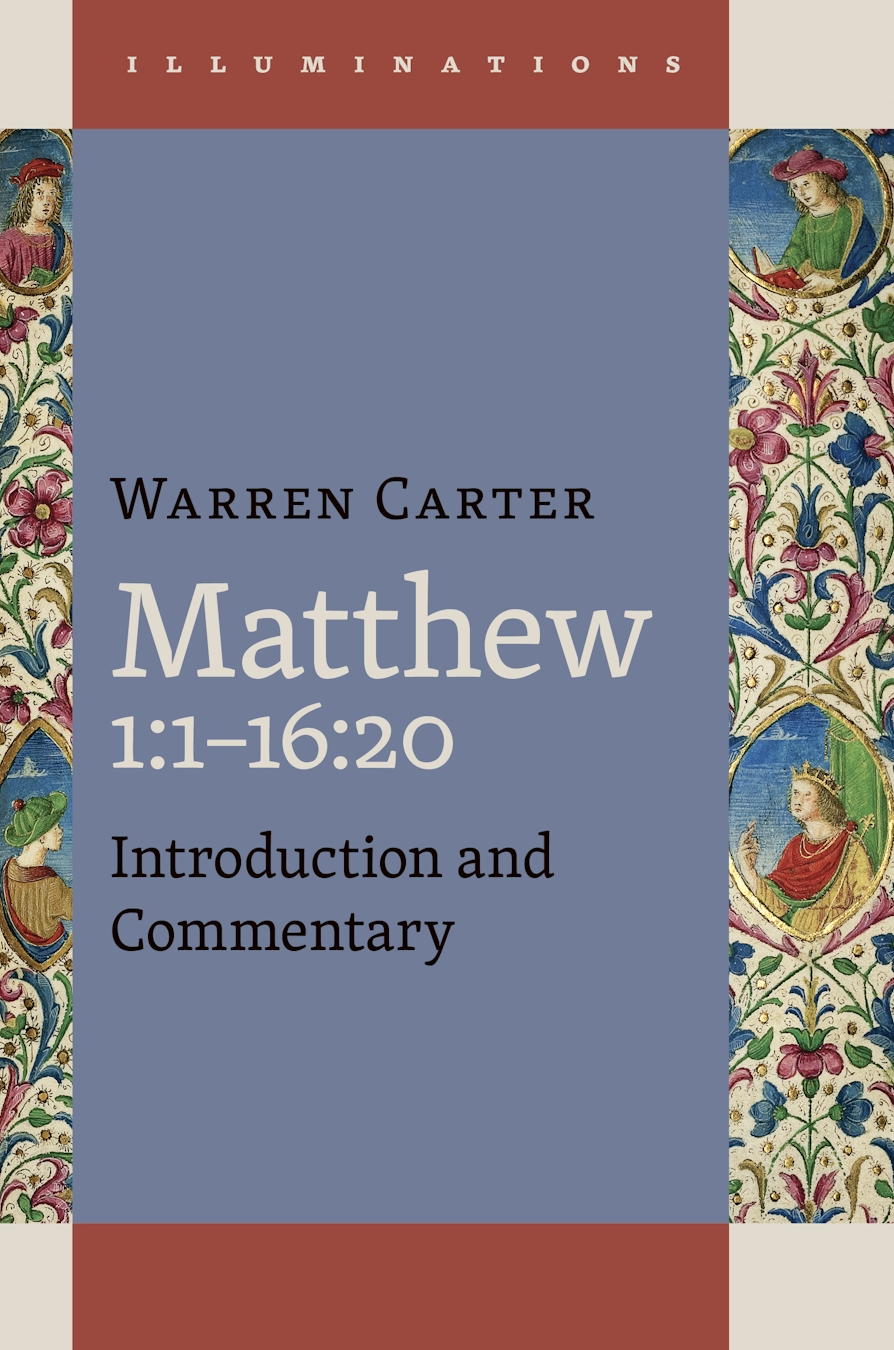
Illuminations Commentary Series. Grand Rapids, MI: Eerdmans, 2025.
The Gospel of Matthew, commonly and fittingly referred to as “The First Gospel”, has enjoyed a long and extensive history of scholarship, and subsequently a significant amount of monologues and commentaries have been committed to its interpretation, understanding, origins, transmission and the part it played in the development of Early Christianity (EC). Among these various works comes the new contribution to the scholarly discussion by Warren Carter, a two-volume work as part of the Illumination commentary series. Carter’s (hereafter C) commentary can best be described, in this reviewer’s mind at least, as a wholly unique and refreshing contribution to Matthean studies as well as being a work which is highly accessible and deeply insightful. The two-volume work is by no means small, being just under 2,000 pages, though its pages pass with ease. C’s writing style is captivating, his points made succinctly, and his coverage of the gospel and its cultural and historical backgrounds comprehensive (as he aims for it to be). Frequently throughout his work C repeats various points, but he does this not in a cumbersomely repetitious manner but in a gentle and important style, reminding the reader of various important points. For a work of this length, it is impressive enough that C manages to engage the reader at every page and carry the work forward in a consistent, cogent, and complimentary manner. I would strongly recommend the commentary to any individual who finds themselves interested in Matthean research, and I do believe that the work will cement itself as an invaluable contribution to study of the gospel. It is one which can be gleaned from by the scholar, and much gained from it by the layperson, alike. I believe, too, that the work is indispensable for the pastor, as many of C’s points, arguments, and various emphases are very important and relevant for not only pastoral applications, as well as general applicatory principles for believers, but insightful to timeless (but especially in recent times) social, cultural, and relational issues. C’s work, therefore, speaks to these issues in a rather beautiful and refreshing way.
C’s work ought to firstly be called unique, and for a variety of reasons. An “academic word”, or “element”, might firstly be noted. C’s work is distinctly concerned with imperial concerns, that is with the influence, concern of, and rhetoric / polemic against and with the Roman Empire. This topic is that which C’s other works often oscillate around. I, for one, am typically hesitant to this topic and its elaboration within New Testament (NT) texts, as I feel that it is often conflated and treatments emphasizing its relevancy false-positives. One thinks of the back-and-forth (though not direct) of John M. G. Barclay’s reasoned and seasoned reflections on N. T. Wright’s idea of “coded” responses to Rome in Paul. In short, I find imperial foci to lack exegetical validity and to find such validity only in the generic reality that, well, Rome certainly existed. Instead, I find it to be that the Scriptures are hardly ever concerned with Rome beyond variegated connections in eschatological senses. C, however, masterfully navigates this theme. All throughout the work one will find C envisioning Matthew as responding to the cultural and societal (mis)norms of his day, placing Jesus as replacing the oppressive and altogether-negative imperial rule of Rome with the coming Kingdom of God. This is reflected quintessentially with C’s replacement of the word “Kingdom” with “Empire [of God]”, and at various points he comments on this choice of translation. It is far too much for us to touch on the various ways that C does this, but it is a particular theme woven throughout the work that has much to be said about it, and I think that such a view positions C’s work as unique and deeply insightful, especially as we apply these various ideas and principles to our own modern world.
As C comments in his preface, “I have not written this commentary as a comprehensive treatment of the Gospel of Matthew. Nor have I stuffed it with random, unconnected pieces of data. Rather, this commentary develops the central thesis that Matthew’s Gospel negotiates an intra-synagogal conflict in the context of its post-70 CE world and the massive assertion of Roman imperial power transpiring during this period” (p. xvii). From the horse’s mouth itself, the reader should not expect a typical commentary from either the layperson or academic approach—something which is, more or less, nothing short of recapitulating extant views and interpretive approaches (which, for instance, Stanley Porter has railed against in recent years, commenting on the issues with modern commentaries, and their incessant proliferation). Instead, C’s work provides a treatment of Matthew that paves its own path of sorts, yet does not exclusively fit into any description, even one which C himself provides. I would say, if I had to, that C’s commentary is one which analyzes Matthew within its immediate textual context and compliments this against the prior, present, and immediate-future existence of the emerging EC group which has carried the oral traditions, transmitted, and/or received the gospel. His work is concerned primarily with the text itself and its interconnectedness, rather than a full rehashing of the plethora of (possible) Jewish background data, and is concerned more with the Roman, imperial and social background and (immediately relevant, though at times implicitly so) that of the Greco-Roman world. I believe this is a faithful description, and assists in (unsatisfactorily, of course) understanding the tenor of the commentary.
C avoids sufficient discussions which mark other (exegetical, especially) commentaries. In the Introduction, he lays out seven primary aims: (1) that Matthew belongs to the genre of ancient biography, though with some differences (cf. pp. 4-12), (2) that this story utilizes a plot of “six sections or narrative blocks”, (3) that is “addresses followers of the Jesus movement living in the last decade or two of the first century”, (4) concerns itself with the social world of the post- (and, I would add, pre- and present) first century world (p. 3), (5) concerns itself with the events which followed the conflict of 70 CE, (6) deeply “engages the socioeconomic realities of daily urban and rural life in the ancient Roman world of Syrian Antioch”, and (7) has been read and thus interpreted in multiple ways (p. 4). This list aptly captures the commentary’s vision and its contents. For structure, which is important to C, he follows Seymour Chatman (1978) in seeing Matthew as employing literary kernels (major events) and satellites (minor events) in order to lay out the story (p. 13), adding that “Chatman states that kernels are the skeleton of the narrative block while satellites form the flesh on the skeleton” (p. 14). For C, there are six kernels: (1) is 1:18-25, where “God initiates the plot’s action through the Holy Spirit with Jesus’s conception and commission to manifest God’s saving presence”, (2) is 4:17-25 where “Jesus now begins to carry out his commission to manifest God’s saving presence” (p. 14), (3) is 11:2-6 and is a “branching point” which webs together the conflicts in the gospel, (4) is 16:21-28, another “branching point or new development” of Jesus’s declaration of “his coming suffering, death, resurrection, and return as Son of Man”, (5) is 21:1-27, which “moves the plot forward with Jesus’s entry to Jerusalem” (p. 15), and (6) is 28:1-10 which, again, “moves the plot forward with the resurrection of Jesus” (p. 16). The “satellites” strengthen the focus and point(s) of the kernels and add to the major theme(s).
For authorship, C takes the traditional readings of the Two Source Hypothesis, Q and M, Markan priority, etc. at face-value and concerns himself, instead, with the final form we have (p. 18). For location, M seems to mostly land on Syrian Antioch being where the gospel was written. Though noting the arguments “are not strong, they are stronger than any of the arguments supporting other proposed options” (p. 21). C provides a hearty discussion on the post-70 world of Antioch (pp. 26-43), reading Matthew in this environment (pp. 43-48), and especially in the context of synagogal conflict (pp. 48-62). This last section is important as it contextualizes and situates a great deal of C’s discussions and points throughout the commentary as it details and deals with the manifold conflicts between the Matthean Jesus and the Pharisees, scribes, and religious leaders (which he emphasizes the political and social nuances necessary to be read with what is otherwise and oftentimes glosses as mere “religious” leaders; C associates, frequently and well, the religious leaders as Rome-allied elitists). C moves to “The Socioeconomic Realities of Daily Life in the Roman Empire” (the section’s title; pp. 62-74), an (almost) equally important part of his introduction, and finally looks at the interpretation history, which C admits that “Such attention can be partial at best” (p. 74), and for perfectly valid reasons, with this section coming in at short of 8 pages (pp. 74-81). While one may desire a longer “History of Interpretation” section, C satisfies those wants not only by pacifying them due to the inherent ambiguity and subjectivity of this, but by providing insightful and sufficient treatment of interpretive histories throughout the commentary in his liberal and intriguing “History of Consequences”.
Given that commentaries are particularly difficult to review, without recapitulating every view expressed therein, and any choice sections are inherently subjective, being chosen at and by the will and whim of the reviewer (i.e., their preference(s), prejudice(s), or general interests), we will not attempt to do so. Being almost 2,000 pages, such a feat would be silly. Some comments are necessary. First, C seems to take an indecisive view (or chooses not to elaborate) on several details most commentaries do concern themselves with, most glaringly with the divinity / deity of Jesus. Though he frequently and consistently occupies attentiveness to the various tropes and associations with him (as teacher; Christ/Messiah; Son of God; agent of God; even as Son of Man, and against influence from Daniel [pp. 1:46, 59, 504, 522, 571, 613, 628, 932, 944; 2:14-15, 33, 173, 183, 240, 302, 491, 514, 519, 534, 537, 589, 592, 594, 634, 676, 725, 728]; Immanuel, and as saving from sins), no sustained discussion (to my knowledge) exists on making a case for or against Jesus’s divinity or deity. Instead, C prefers to identify him primarily as God’s commissioned-and-enabled agent. For instance, on John’s baptism of Jesus C provides little discussion on the topic. Though he identifies the act of baptism as commensurate with the expectations of Israel’s history and setting into motion the deliverance of Israel (pp. 204-206), as well as the baptismal, heavens-opened, and dove-descent, and Spirit-filled language as being reminiscent of Ezekiel 1:1, lightly echoing Genesis 1:2, and mirroring that of various biblical figures receiving the empowering descending Spirit (p. 206), and providing a rich and unique background to the bird imagery from the Greco-Roman world (pp. 206-207), he seems to see little of Jesus’s person, from the typical Trinitarian or divinity perspective. For example, he sees the term “Son of God” as a use of catachresis, and Jesus primarily as the chosen agent (p. 209). This also fits with his view on the infamous 24:36, where “Jesus’s lack of knowledge concerning ‘that day’ is consistent with his identity as an agent or representative of God who is not God’s equal” (p. 2:498), despite this ignorance being “somewhat surprising given the intimate relationship between the Father and Son expressed in 11:25-27” (ibid.). Though I may have entirely missed sustained (less-likely) or minor (more likely; even a possibility) discussion on the topic, and apologize if so, it seems like C does not move beyond the view of Jesus as God’s (eschatologically-placed) divinely commissioned and empowered agent of reconciliation.
Two other comments suffice for our purposes. As is interesting to me in particular, C seems to dismiss both antinomian interpretations of Jesus’s handling of the Mosaic Law as well as having a somewhat post-supersessionist reading throughout various parts of the commentary. For example, on the incredibly contentious passage of 5:17 (-20), C dismisses the typical views of the use of “fulfill” (pp. 344-345), and views the so-called “Six Antitheses” in 5:21-48 as “six examples explicitly draw[n] from scriptures that are [then] being interpreted by Jesus…in accord with what is here framed as the right or authoritative interpretation of the divine will” (p. 315). He adds, “[The] formulation of an antithetical or contrastive relationship [in the Six Antitheses] is not convincing. A claim of abolition or destruction of the scriptures cited in the first part would directly contradict what Jesus has just emphasized in 5:17-18” (p. 320). While on this topic and this section, C’s exegesis and interpretation of the so-called “Six Antitheses” does not follow with standard practice, of over-application-interpreting them or recalling rabbinic parallels, but insightfully and beautifully applies it to the (then) present-day struggles under Rome’s terrible socio-economic and cultural thumb, which he does with the Beatitudes, too (pp. 320-336; cf. 306-312 for the Beatitudes). These two views—eschewing antinomian readings as well as fully supersessionist ones—are carried throughout both volumes of C’s work, and foster a rather refreshing and embraceable reading, providing an approach to the text which is oftentimes avoided by most modern writers (well, perhaps not so much in the last few decades since E. P. Sanders’s landmark 1977 publication).
C’s less-antinomian views are likely part-and-parcel with his larger interests of the social, cultural, and relational perspectives of the gospel as it looks to the disparaged and seeks to present Jesus as the one who restores their dignity, calls people to lovingly relieve them, and uses the Jewish religious leaders’ failure to meet this biblical and divine call polemically, rhetorically, and purposefully. However, while C envisions this polemical thrust against the Rome-allied elitist religious leaders as occupying a great deal of the gospel, he charitably acknowledges that much of the text is not as vicious and depredating as many (critical and modern) commentators and thinkers see. A perfect example is probably with his commentary on chapter 23, a section which C notes as a major motivator for later antisemitism and false caricaturizing of Pharisees, with this naturally spilling over into classifying all Jews into this (false) category (p. 2:392). Following Luke Timothy Johnson (1989), C demonstrates that the rhetorical nature of the chapter is not unlike standard contentions of the day (pp. 393-395) and should not be read as it usually is, but rather with various approaches he outlines (pp. 395-402), and primarily through is own “Imperial-Critical Reading” (pp. 402-406). C’s section on Matthew 23 is actually one of the best that I have ever read (in full, 2:390-462) and must certainly be interacted with for any study forthcoming to be regarded as adequately interacting with the research on the data and text. As I have mentioned, the section is marked by C’s peculiar (in a good way) and insightful attention to the socio-economic and socio-cultural backgrounds of the gospel, and he applies this framework in unexpected and wonderful fashion when looking at the Pharisees’ various traditions, whereas most commentators are concerned (albeit rightly) almost exclusively (not rightly, i.e. “exclusively”) with the Jewish and rabbinic traditions background.
I do not believe one must be convinced of C’s ideas of Matthean location in Antioch, its dating within the contentious environment of the post-70 CE world, or his emphases on social, cultural, economical, and imperial concerns to benefit immensely from his commentary. In fact, I believe that his points and arguments warrant the reading of every serious student or scholar of Matthew, and that his contributions, at the very least, provide an incredibly important and implicatory perspective that is hardly ever taken (seriously) into consideration. Moreover, the details we have briefly outlined in this review fail to present the broad and nuanced assortment of discussions, proposals, and ideas C expresses throughout the commentary. In short and sum, C presents to us a commentary on Matthew that is unique, excellent, and deeply insightful, and will certainly find itself as a valuable resource for and contribution to Matthean studies. This is especially true in pastoral applications, where I believe that C’s work presents the most potential and value, and for that reason I believe the commentary should be placed (a higher spot, too) on the Top 5 resources for Matthew for both pastors and students alike, yet still immensely beneficial for the scholar as well. I thoroughly enjoyed the work and will find myself returning to it frequently, of that I am sure.
Special thanks to Eerdmans, the publisher, for providing me a copy of the commentary. My opinions expressed above are my own and reflect my honest views of the work, being in no way influenced by the publisher, author, or any other person or establishment.