
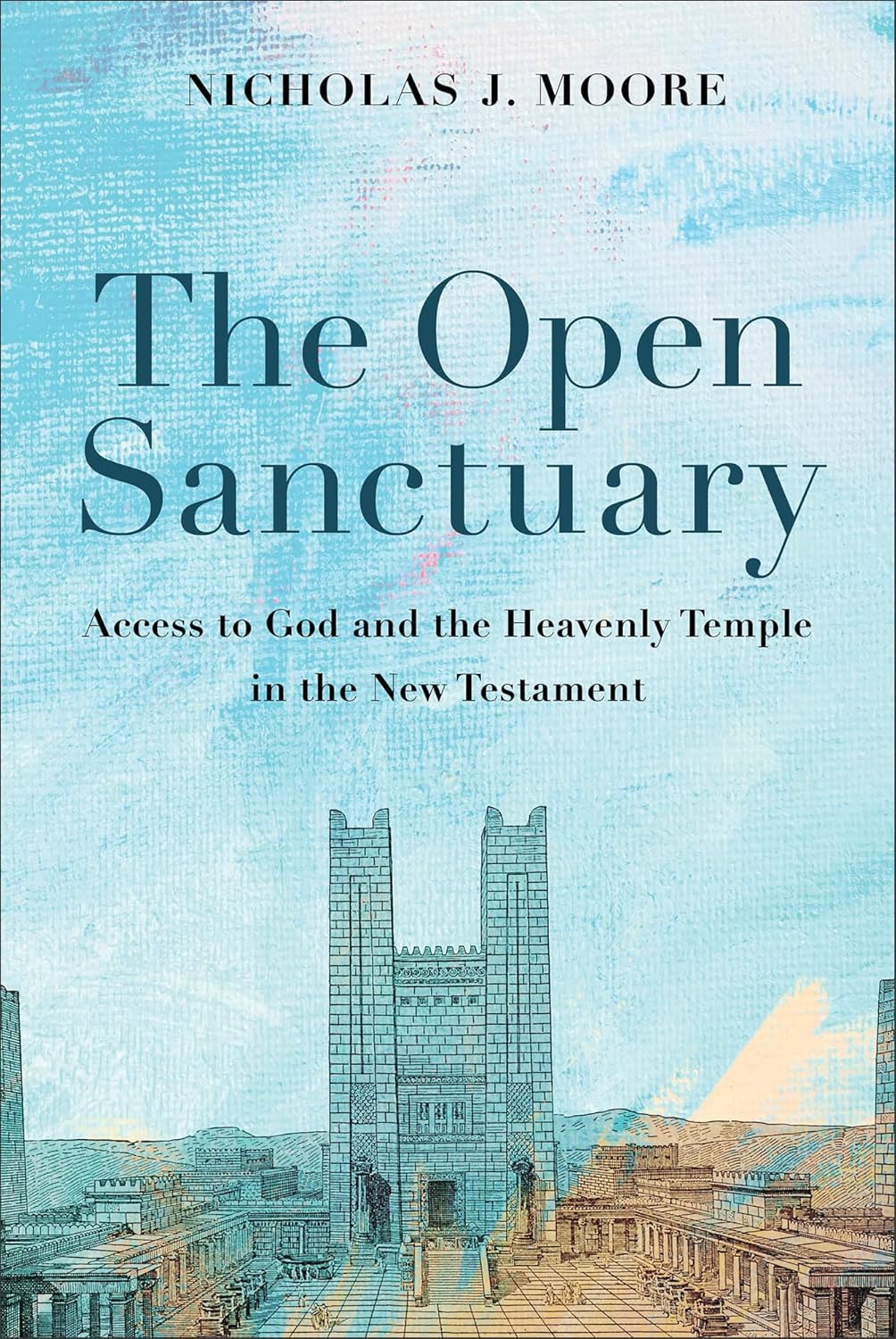
Grand Rapids, MI: Baker Academic, 2024
One of the most glaringly neglected topics in NT research is that of the temple, and specifically with how the temple relates to Christology, soteriology, and ecclesiology (the study of Christ, salvation, and God’s people, respectively). That isn’t to say that there hasn’t been a significant amount of research on the matter (there has), but one would imagine it deserves more attention than it has been given. In The Open Sanctuary: Access to God and the Heavenly Temple in the New Testament (Baker, 2024), Nicholas J. Moore both contributes to the filling (or bridging) of that gap and provides a relatively bibliographic work bringing together various views towards the temple in the OT and NT. Additionally, Moore (hereafter M) provides a new way forward (a reconfigured “map”, as he calls it) from the “standard” view that has taken hold within recent years’ publications of the temple as a microcosm of creation, popularized in the last decade or so in a variety of publications. For M, a new taxonomy is necessary in allowing the various ideas and conceptions of the temple in biblical literature to coalesce. This fourfold taxonomy “describes a spectrum ranging from [1] blueprints in heaven, through [2] a temple building in heaven, [3] temple and heaven as coextensive entities, [4] to temple as cosmos” (p. 33).
This taxonomy structures M’s work, he says, yet not in the form of the chapters, as one is left wanting for a conclusion as the book progresses. This is by no means a negative thing, as M provides what I believe to be the most insightful—not merely data based and reiterating the obvious, but in making logical, intertextual and insightful connects—treatment of the temple theme in the NT to exist so far. His chapters naturally unravel what is going on and the view in each set of literature’s view of the temple and heaven, but M avoids giving explicit conclusions at any point, which is warmly welcomed, rather providing syntheses and conclusions at the end of each chapter on what was discussed. In the Conclusion, M writes that “The gospel is, in part, temple-shaped, and the texts produced by early Christians reflect this”, adding that “Their map of reality enabled them to plot in a cultic frame who Jesus was, what he had accomplished, and where he now is” (p. 187). After summarizing the book’s findings and issues within scholarship which preclude such views or approaches, M concludes that “The notion that heaven is a temple is a common presupposition across the NT, one shared with the wider Second Temple Jewish world, and one that has left its mark even on texts that do not explicitly dwell on or explore it” (p. 193). Rather than most views, then, for M heaven is itself a temple and maps onto and across this taxonomical spectrum, pulling together the various (and oftentimes seemingly differing) views across the biblical corpus and associated writings. In my mind, M’s views are not only strongly persuasive but fail to find a single point of contention, and I would warmly (and will) recommend his work as the most important to hit the press. Moreover, M elegantly balances the fine line of academic rigor and writing for accessibility. Both layperson and scholar alike would benefit from this work, walking away with much to think on and to further explore.
M’s work is divided into an Introduction, eight chapters, and the Conclusion. In the Introduction, M welcomes the reader into the conversation, the need for the present work, and the plan of the book. In chapter one M surveys the ancient idea of temples and sacred spaces as cosmic centers, which has been capitalized on by many studies. For M “The various construals of the cosmos-temple relationship (imitation of creation, imitation of what has been made above, cosmic center) are not highly elaborated in their own right, and they should not be sharply distinguished” (p. 15). M also discusses, and essentially dismisses, the typical idea of Eden being a sanctuary, and that the temple subsequently reflects this. Following those such as Block and others, and being incredibly charitable with those he distances from, M contends that “The evidence [in the OT temple against the ANE] demonstrates that Israel’s sanctuaries evoke Eden, but this does not entail that Eden is a sanctuary” (p. 19). The conclusion continues with a succinct and very insightful overview of the OT idea of the temple and an equally succinct and insightful overview of the ideas of temples and the cosmos in Greco-Roman thought, bringing up points that M will briefly bring up throughout the book. In chapter two, where M introduces his taxonomy, is where he actually tackles the idea of microcosm thoughts of the temple. Here he reintroduces his taxonomy in more detail, which is necessary to reiterate here for the reader’s sake, as M smoothly flows over and fills cracks that any (limited) review may seem to paint or imply:
My proposal is that we should conceive portrayals of the heavenly sanctuary in the [STP] period on the model of a spectrum, described via its four most salient points. The first point is a temple-plan in heaven, whereby there is a blueprint of some kind in the heavenly realm that it shown to a human being (usually Moses) who then proceeds to construct the earthly sanctuary. Next comes the notion of a temple in heaven, where there is an actual structure within the heavenly domain. The third category…is temple as heaven, where heaven lacks any distinct structure as such but rather is itself a sanctuary—that is, heaven and the temple are coextensive. Finally comes temple as cosmos, where the whole universe is a temple, usually with (the highest) heaven as its most sacred precinct and earth and sea as outer chambers or courtyards. It is worth reiterating that these four points do not represent silos but rather form the key points along a spectrum of views ranging from minimalist to maximalist in their understanding of the scale of the cosmic temple, and they shade into one another at the edges (p. 38; emphasis original).
The rest of the chapter fleshes out these various points on the spectrum in various OT, STP, and other thinkers, demonstrating that the microcosm view is “inadequate” (p. 50). Having covered the background views of the temple, in chapter three M moves into Revelation where the sanctuary is explicitly described as being in heaven (p. 63) and is a place that, such as under the altar, saints find refuge and that, once opened, brings judgment. In Revelation, often a point of contention with temple-and-heaven ideas, “heaven and earth have not disappeared in the New Jerusalem but have come together” (p. 72), and the community-as-temple idea does not “override the emphasis on heaven…as the spatial context in which people meet with God and know his protection” (p. 75). In chapter four, M entreats Hebrews, which is probably his most interesting chapter (in my opinion). Here M sees Jesus’s ministry “fulfilling and combining the two spaces of the Mosaic chamber and leaving only a single chamber now decisively opened and inhabited” by him (p. 78). Providing a short but fascinating overview of familiar language of “shadow”, “copy”, and “sketch” with respect to the temple (pp. 79-83), M posits that “the heavenly tabernacle precedes the earthly one, ontologically and temporally” and that “This means that the earthly tabernacle in turn can reflect and foreshadow Jesus’s ministry within it” (p. 83). In the chapter M also provides a fascinating view into the daily (tamid) sacrifices of the temple and how Christ fulfills them and that his death, though presented primarily in a Passover context, is elaborately portrayed as a once-for-all sacrifice in a Yom Kippur / Day of Atonement one in Hebrews (pp. 86; 92-95). Again, this chapter is probably the most interesting, with M providing a host of solutions to various issues resolved by examining the Greek (ex., p. 89; 91; 93-95; 96-97) answering issues of Christ’s work through the temple, his continual offerings, his own offering, and comparison to the Levitical services among other things. Ultimately in Hebrews the sanctuary foreshadows Christ’s ministry (p. 100) and is formed into a single chamber, the veil and holy of holies opened up, via his ministry (p. 101).
In chapter five M moves into the part of the book which can at times feel like drawing together strings and making connections more than actually continuing within the same stream of thought that grounded the first parts. In other words, the book starts to pick up on the backgrounding of temple-in-heaven ideas rather than these being foregrounded, and suggestively acknowledged by him in that on the first page of chapter five we are “heighten[ing] our sensitivity[ies] to echoes of the heavenly temple in the texts we now examine” (p. 103). This chapter (five) covers Mark and Matthew. M covers the Markan connectivity between Jesus’s baptism, transfiguration, and crucifixion (pp. 105-109) and Mark’s reliance upon a backgrounded temple. In the second part, M tackles Matthew’s gospel, through his “Temple Presuppositions” (pp. 116-118), “Mountains” language (which M connects earlier; the mountain imagery of sacred spaces; pp. 118-120), and Matthew’s portrayal of the “Mini-apocalypse” of the crucifixion. In chapter six M entreats Luke and Acts, which follows the same trajectory of temple echoes throughout. Though M makes some fascinating insights, such as with respect to the transfiguration and incarnation (p. 127), the Pentecost event (pp. 133-135), and the daily (tamid) times with Peter and Paul’s Lukan experiences (pp. 138-139), and some various temple allusions, the chapter seems like it was fit into a necessary (or supposed) structure.
Chapter seven moves to the gospel of John and recaptures the book’s focus, or better it refocuses the book’s aims which are somewhat muted (or dulled) in the previous two chapters (which is not an issue with M, but simply what the authors are interested by and therefore write about). M gifts us a fascinating bit of insight from a temple-based perspective on John 1 and Jesus as the Word (pp. 148-151), which I found so compelling on a couple points that it will actually probably shift the way I read and articulate the Prologue in some of its details. M also covers the stairway to heaven in John 1:35-51, often neglected by many (including myself!) as being of obvious importance given its proximity, and an interesting overview of Jesus’s meeting with the Samaritan woman in John 4 and various temple implications (pp. 155-158). He then moves onto John 10 and 14, spelling out the temple implications therein, especially with overruling and eradicating false ideas of the “many houses” or “mansions” read into John 14:2 (p. 161; pp. 161-163). This chapter, though still suffering from the not-as-explicit ideas relayed about the temple in the literature as the others, really demonstrates the value and insight of M’s general thesis in how the temple elucidates so many points of contact in the NT. Both backgrounded and foregrounded (which, neither is necessarily more pressing on meaning), the temple serves as something influencing the NT authors’ ideas and articulations of Jesus, his actions, and the significance therein.
Finally, in chapter eight M investigates other literature, including canonical (Ephesians), patristics (Shepherd of Hermas, Barnabas, Irenaeus, Polycarp, Ignatius, 1-2 Clement), and pseudepigraphic (Ascension of Isaiah, Epistula Apostolorum, Apocalypse of Paul), showing how the motif and idea of a heavenly temple continued throughout later Christianity. Curiously, M hardly mentions Paul’s language in 1 Corinthians 3 and 6 (only mentioning them in passing a few times throughout the whole book) and finds no other connections in his epistles (disputed or undisputed) to the temple, which I find rather curious. Eyal Regev has picked up on certain clues in his work (The Temple and Early Christianity [Yale, 2019]), which M cites frequently, and I believe there is a quarry to be mined there that I had hoped to have seen probed here more. The book therefore ends a bit out-of-order, and I am wondering if a different structure would have been desired. M is a prolific publisher on this topic, having published numerous excellent articles that are relayed in the book all throughout. I wonder if the work was not given a significant amount of attention structurally, as there is no discernable thematic or chronological purpose for the structure, nor a most-to-least-important direction. While the Conclusion is no slump chapter, I feel like the first two chapters dominated the topic and thesis that slowly faded as the book went on, which could have simply been by design: defend and demonstrate the point at the front end; show how this is a reliable view throughout.
Other than the comment above, I only really have one criticism, and it is hardly a criticism proper. In pp. 5-10 M brings up spatial theory, particularly on the work of Edward Soja and his threefold categorization of space, with first-, second-, and thirdspace, yet does not bring this up throughout the work except very briefly at the very end with respect to Jesus’ ascension (p. 194). Granted he admits doing exactly this (p. 9), the brief introduction felt crammed, insufficient, and I could imagine that those who are unaware of the research area would come away with its invoking empty. I understand why M needed to (and should have, indeed) included this brief section, but it should have been extended at least a few pages or simply omitted. Almost too little but too much. Or, another option would have been in simply providing more than thirty two words in the conclusion on Soja and thirdspace (p. 194). The issue is that M’s study would have become more than it was, and I am most likely biased here as my area of interest in research is the temple, and particularly cognitive linguistics at the junction of Christ, the temple, and participationism (i.e., space). However, for instance, where M glosses over and deals with the issues of spiritual ascent and upward movement in peoples’ minds and the natural connotation of physical verticality (i.e., heaven is directionally “up there”, where the sun and stars and stuff is), all set against the larger argument and ancient cosmogonies, cognitive linguistics would have been immensely helpful here. The idea of the VERTICALITY schema and the plethora of conceptual frames at our disposal would have been able to beautifully add to M’s argument not just here, but across the entire study. Admittedly, this would have created the (probably unintended or desired) need for a much different direction and likely end up being a distraction. So, “hardly a criticism proper” (above), and likely just because this is essentially what I find to be a lacuna, and one which I’d like to fill [His last chapter’s title, ‘Cosmos, Cultus, and Christ’ is actually a title I had considered after I realized my original, ‘The Liturgy of Creation,’ was taken by Michael LeFabvre (2019)! So, now I’m onto option #3. Oy vey].
However, there is some legitimacy to these contentions, and it is that heaven, space, and cosmogonies are simply left a bit glossed over. This is especially true with cosmogony, which is a question likely not asked by most readers, but the book feels weaker not addressing it. I’d add here, too, that three missing topics and subsequent studies are (1) other presentations of the temple, and temple-as-community, most notably by G. K. Beale (2004), from an OT perspective; (2) ideas and presentations of heaven at large, particularly in both STP Jewish ideas of the heavens and against the larger idea of ancient cosmogonies; and (3) my own ideas of space at this intersection and the employment of metaphor, most recently expounded upon by David A. Basham (2024; but his McGill dissertation was defended 12/2022) but would probably have benefited the study. Additionally, (4) a background of the sacrifices themselves and the functions of the temple would almost seem necessary (most recently, probably Rillera (2024). I feel that throughout the work, M simply did not interact with enough contrary views or background information that would have proven helpful. Simultaneously, however, I can equally (and perhaps even more) see how these would have ultimately been distractions, especially if “taken to the full extent”. These things considered (other than [1], where I do think M’s work needed some more filling out when quickly proposing a different view), I still believe these ideas are questions asked more so by those involved in the research area, and I don’t think their omittance actually weakens his arguments in the end. I suppose that is a testament to the quality of the work, in that M persuasively argues his case without the need for all of this “extra stuff”.
In the end, what we have is a work which stands on its own and is certainly a work not only persuasive in its goal(s) but deeply and unexpectedly rich in its insights within the topic but also on a variety of other points. Consequently, I find M’s work to be a fascinating, extremely important, and indispensable contribution to the discussion of the temple in general, not just to the heavenly temple in the NT. Almost every page warrants the use of a pencil (underlining), and the reading of the work has not only added significantly to my own research, but clarified a good amount of ideas I either had and don’t have now or that required adding onto that M provided. I would strongly recommend the work to anybody and everybody either researching the temple or interested in it and Jesus’s role within it. I deeply enjoyed M’s writing style which is approachable, fresh, and captivating, and he provides a healthy (pp. 197-222) bibliography, complete with clear and filled out indexes of authors, sources, and subjects (pp. 223-240). This is certainly a work that a review cannot do justice to, and I find it to be well-worth its affordable price.