
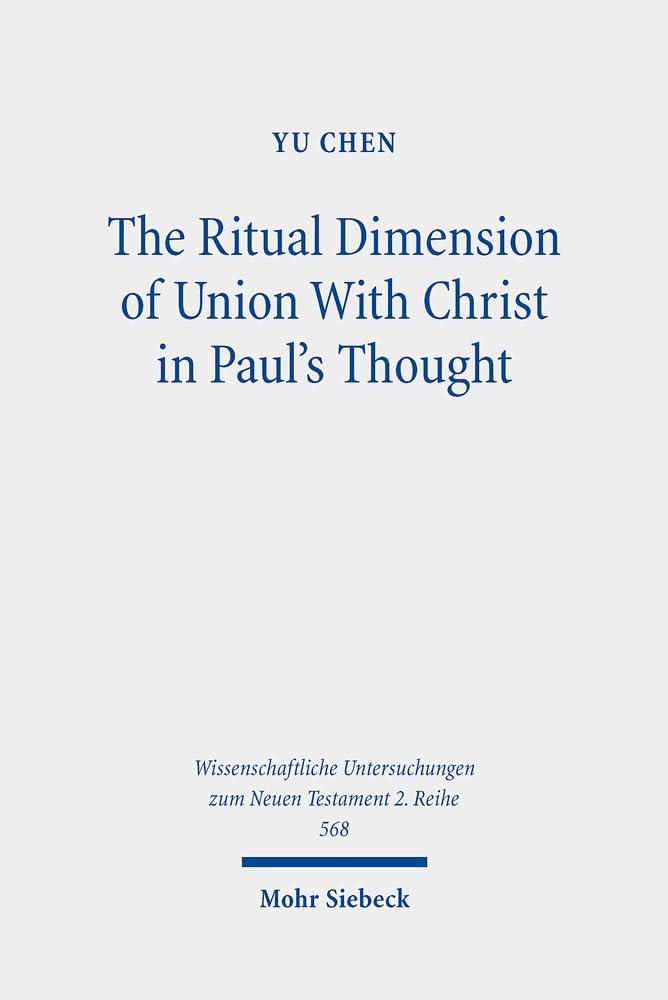
WUNT II/568. Tubingen: Mohr Siebeck, 2022.
The scholarly landscape finds a lacuna between ritual theory/studies and participationist notions of soteriology filled in Yu Chen’s 2022 study The Ritual Dimension of Union with Christ in Paul’s Thought. In his preface Chen himself notes that he saw “a lack of interest in the sacramental or ritual aspect of ‘in Christ’ experience in the current works,” and that this “began the investigation of the ritual aspect of union with Christ” (n.p.). Identifying where the academic world was lacking, Chen’s work is therefore an attempt to provide that need, with this study being a revised edition of his PhD dissertation at Edinburgh University. Chen’s (hereafter C) study is neatly divided into six chapters and, as I believe, stands as probably the best reference and study work for the topic to date. C’s writing style is readable and captivating, his research thorough and expansive, and the work all around informative and stimulating. I would strongly recommend the work and greatly enjoyed reading it, finding myself coming back to it several times since. In chapter one, C investigates the history of research (pp. 3-11), succinctly introduces the reader to ritual theory, study, and history in the Mediterranean world (pp. 13-37), and provides his thesis statement (p. 38). In chapter two, C investigates baptism as ritual performance; in chapter three, he applies the same approach to the Lord’s Supper; and in chapter four focuses on Paul’s participatory language within this “ritual dimension.” Chapter five is involved with the relationship between pistis (“faith”) and ritual, and chapter six concludes the study with a summary of the study, implications, and and future research proposals. C provides a healthy bibliography hovering around twenty pages (pp. 205-224) and a welcomed index of sources, modern authors, and subjects.
C’s general thesis is that the ritualistic elements and practices of the sacraments denote a deeper union with Christ, actualizing for onlookers and participants their cosmic and imagined union with him. In his own words, baptism and the Lord’s Supper “affect union with Christ by transforming believers into a new existential status, incorporating them into the body of Christ, and participating in the salvation event of Christ’s death and resurrection…religious rituals mediate between the world of physical experience and the world of metaphysical imagination” (p. 38). C’s overview of scholarly research is short but sufficient, and he covers the landscape of ritual, union, and sacrament scholarship relevant to his arguments. Here he begins to provide a working definition of ritual performance, where he writes that “Ritual performance is a ritual action whose structure includes a logical object and appeals to culturally postulated superhuman agents, which entails the generation of the concept of the sacred and sanctification of the conventional order whose function is penetration into human actualities, enactment of exceptional relationships, and emergence of social realities” (p. 17). C notes the overwhelming similarities between Christian and pagan rituals, namely in their idea of “cleansing human beings to make them fit for their encounter with the divine” (p. 24), and notes that “all material objects in ritual performance are a symbolic representation of higher realities that lie underneath them” (p. 30). These models in society are “cognitive maps” and “heuristic tool[s]” employed by those participating (p. 32) and are defined by the meaning impressed upon them, i.e. what it is that they symbolize in their practice. But as C argues throughout, these—the bland symbols and the beliefs they are described by or describing—work together to locate the meaning within a metaphysical reality. Here is where C’s study is immensely interesting, and profoundly impactful, as he notes the importance of further contextualizing the cognitive, social, and religious impact rituals would have on the early church.
Moving to chapter two C tackles 1 Corinthians 12:13; 6:11; Galatians 3:27-28; and Romans 6:1-11 probing information for the significance of baptism, and then moves to ritual form; ritual context; and ritual function for the remainder of perhaps the most fascinating chapter in his work. This chapter is dense and perhaps one of the most significant on baptism written in recent years, with C unpacking a significant amount of information we cannot fully address. C navigates the Jewish and Greco-Roman background of initiation rites and religious rituals, noting similarities from Jewish backgrounds of the overlap of purification and righteousness (p. 51), the use of clothing symbolism used in the mysteries (p. 54) and Paul’s clothing metaphors (i.e., Gal. 3) likely invoking the garment worn by those baptized (p. 57), similar to STP literature’s own bathing ritual attire. For C “The performance of baptism is to re-enact the Christ event, and the participant is to identify with it” (p. 56), and related “baptized into Christ” is associated with a “conceptual space in which baptism takes place” and such phrases denote “a mental sphere into which one is granted admission” (p. 61), bridging the gap between C calls “the mythical past” of Christ (p. 62), positioned additionally as “the superhuman agent” in the religious ritual actions in which this agent is embedded (p. 72). Applying this background of conceptual salvation space that ritual creates, “For this reason, Paul is adamant that the Galatians should not undergo a second initiation rite, the rite of circumcision” (p. 74).
Briefly entreating the “fundamental typological role[s]” (p. 77) and “prototype[s] of dominion” (p. 78) that Adam and Christ describe as realms of dominion, believers undergo the washing away of pollution and sin in baptism unto the state of purity before God (p. 79) which weds the ideas of purification and justification (p. 81), both describing, for instance when applied to Galatians 3, the “interior space of transformation” (Gal. 3:27, p. 82) and “the emerging social reality resulting from the ritual performance” (Gal. 3:28, ibid.): “baptism translates the participants into a Christ space in which the transformation happens” (p. 83) and this can be seen as a “virtual space” which reconfigures believers’ reality in Christ (p. 82) which is likened unto transformation from the terrestrial sphere into the celestial reigning with Christ (p. 83). Ethnically this engineers a new humanity in Christ (p. 86) and rests on “both cosmological and anthropological dimensions” of eschatological new creation soteriology (p. 90). In short, baptism officiates a new conceptual reality and existence believers acquire through the rite, emerging from the ritual as a new creation and redefined person and peoples—individual and corporate—in Christ, with the baptism ritual, and associated ritualistic elements and objects, identifying believers as those associated with and connected to Christ’s own salvation-creating past (the history of the gospel) and immersed in the new identity he has created in the cross.
In chapter three C moves to the Lord’s Supper, where C begins noting general similarities on a broader and ritual-centric level: “despite some different elements in each type of eucharistic meal, there remain a core tradition underlying all of them: to wit, the parallel statements for the respective blessings of bread and wine, the common stock of a eucharistic vocabulary, and the shared eschatological outlook of the meal ritual. Given the common tradition underlying all these meals, the argument that the institution is not related to the communal meal cannot be substantiated” (p. 99). Unexpectedly this section tackles the topic of the Lord’s Supper-eucharist disagreements. As worship behavior and thus closely related to a eucharistic meal (p. 101), we can see that the connection between the Passover meal and the Lord’s Supper “underscores that both rituals serve as a founding rite for the creation of a new community” (p. 103) and that as a proper meal, not as “bite-sized bread and sips of drink” in later developments, we can understand the eucharistic-like meal in the Corinthian community (p. 109) and that the meal adopted, adapted, and retorted the “sacrificial culture” Christianity emerged within (p. 111). For C, then, the early Christian communal meals served, like baptism, as community and identity-forming ritual meals. Paralleled against the myth background of the exodus, of “a new community out of a chaotic society,” and operating alongside notions of creation and cosmos out of primordial chaos (p. 125), the eucharistic meal envisions such a reality and actualizes it into the “virtual space” with Christ (p. 129), with Christ as the Agent (p. 121) and sacrificial victim (p. 130) all set against nuptial imagery: “a clear nuptial imagery at the Lord’s Supper emerges: Christ, the new Adam, meets his brides, the ekklesia, in the Temple indwelled by the Spirit at the Table of the Lord’s Supper” (p. 135) producing intimate fellowship with God and one another. Canvassed against the various soteriological and narratological themes of Scripture, ritual meals thus ritualize the reality believers partake in.
In chapter four, C investigates Paul’s notions of participationism and comments that we often find ourselves “locked in a theological labyrinth with no clear way out” (p. 141) but that from many angles “the ritual approach is the way forward because of how it mediates between the physical and spiritual realms,” particularly with respect to “in Christ” language which studies have neglected the ritualistic aspects of (p. 145). Seeing both locative and spherical grammatical uses in Paul (ibid.) which give way to multiple contained meanings C argues for both a “dynamic” and “static” element of participation which corresponds to baptism and supper, respectively, set against the fact that “participation is an act of taking part in the Christ event” (p. 151) of which “ritual,” here “as a technology,” serves to create “a virtual space for re-creation, re-production, and re-configuration within the concrete circumstances of personal, social and historical realities” (p. 164). The bulk of this chapter which we have left unaddressed in this review is C’s thorough and insightful investigation of Paul’s use of prepositions and how the spatial, instrumental, etc. senses correlate to Paul’s ritualistic union in Christ (pp. 151-163). Though such analyses have been committed to by many (but not enough!) C provides another worthy and interesting contribution to the discussion, of which I am a particular fan of. Here C’s careful but insightful exegesis takes shape, where he has no difficulty striking a balance with a topic that is easily susceptible to erroneous approaches. One finds no error in C’s work. As he writes later, “Paul consciously chooses his prepositions by bringing out a specific shade of meaning in his writings” (p. 189).
Moving to chapter five C entreats pistis (“faith”). C investigates the multiple and varied understandings of pistis (pp. 165-171) and argues that “ritual provides a physical embodiment to the performance facet of πίστις in which a new reality of faith is created” (p. 172), and sees here the idea of faith in Christ as putting one right (p. 173). In Galatians 2:19-20, C offers some interesting thoughts seeing baptism as being the background of co-crucifixion with Christ (cf. Rom 6:6) and sees a mirroring between Gal. 2:15-21 and 3:23-29 with pre-liminal, liminal, and post-liminal structuring, which is very interesting (esp. p. 174). For faith, C sees that “the πίστις of the Christ event is re-enacted and re-created in the performance of baptism, when one is fully immersed in water,” with the Christ event / Pistis Christou no longer just “a revelation but it is incarnated during the baptism ritual” where the candidate takes on themselves Christ and Christ then lives in them, with us seeing that “a new creation emerges as the candidates receive a new identity in Christ and become the offspring of Abraham” (p. 175). Coloring in the lines of the argument in Galatians from a ritualistic background is demonstrated by C to be an extremely helpful methodology and one which sees the Galatian believers as having already undergone a ritualistic rite of conversion (or, transformation/transportation) into Christ so, therefore, the rite of circumcision is unnecessary and wrong on more than just religious or theological grounds.
Finally, in chapter six, C brings together his arguments and summarizes his findings. A particular quote is that “The physical movements in baptism and the Lord’s Supper rituals transfer the participants into a Christ sphere, outside the structure of worldly time and space” (p. 197), which aptly summarizes C’s findings that ritual actualizes the reality of being “in Christ”, providing a significant amount of insight into the concepts therein but also providing further contextualizing of Paul’s more polemical arguments as well as his own conception of what participation in Christ means. While these things are naturally beyond human understanding, and the debates over whether we have merely metaphor here or simply, as E. P. Sanders said long ago, that scholars lack a category to fit into Paul’s participation, C provides a very important contribution to developing further understanding of the matter. In all C’s work is a wonderful study and I would strongly encourage anybody interested in Pauline studies and ancient religion in any form to read the work. I believe that not interacting with C’s work within Pauline theology is to neglect a major aspect of his religious world, and thus C’s work is not only warranted, but necessitated. The only comment I would add to C’s work is that I would have appreciated to have seen him interact with Turley’s work, which I have also reviewed. C only interacts with him on two occasions throughout the work (pp. 45-46; 66-67), and I feel should have acknowledged Turley’s work as being exactly what C claimed to essentially not exist. The overlap between their two studies is immense, and both contribute to one another immensely, so for C to not have interacted with Turley on numerous points (which was published seven years prior) is to not have interacted with the scholarly conversation, and I believe doing so would have enriched C’s study on several key points. This does not take away from the quality and importance of C’s work, but I would encourage the reader to invest themselves in both works, and not simply one or the other.