
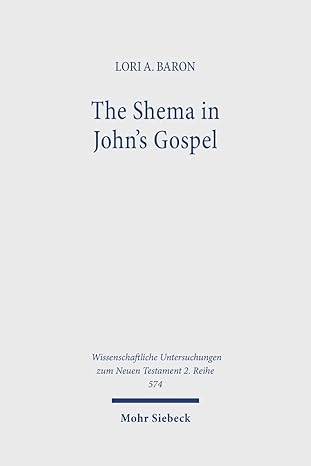
WUNT 574. Tübingen: Mohr Siebeck, 2022
A text so central to Judaism and Christianity as the Shema (Deut. 6:4-9) certainly warrants significant scholarly treatment, and Lori A. Baron (hereafter B) certainly delivers for her readers a contemporary, insightful, and comprehensive discussion of this creedal statement between the first and second testaments. The Shema in John’s Gospel is a revised version of B’s 2015 PhD dissertation at Duke University under the primary advisership of Joel Marcus (p. v). As B states in her introduction, though “the Fourth Gospel tends to go its own way” in handling the Shema, “the present study will argue that the Shema is more central to the Christology and historical setting of John’s Gospel than to any other New Testament writing, that John makes more of the Shema than do the Synoptic authors who cite it” (p. 2). This certainly explains B’s thesis well. She continues to note that the Shema is presented uniquely in John, that these innovations are the result of non-Christian Jews and believers in the first century, and due to conflict over Jesus’ identity, and states that her study “identifies prominent themes found in the Shema (Deut 6:4-9) and tracks them in John’s gospel” (ibid.). Again, B’s thesis certainly mirrors the introductory remarks she provides and she does this quite well.
The structure of the book is mapped by these comments. Wonderfully, the bulk of B’s study is not on the Gospel of John explicitly—which is oftentimes subject to one extrapolating more from the text “than is there”—but in tracing the Shema and its linguistic, thematic, and conceptual links found throughout the Hebrew Bible, STP literature, and the NT. B divides the work as follows: in chapter two, she investigates the Shema in Deuteronomy and unpacks the meaning therein. In chapter three, she follows explicit and implicit references to the Shema in Joshua, 1-2 Kings, Nehemiah, Psalms, Proverbs, Jeremiah, Zechariah, and Malachi. This chapter marks the richness of B’s study, in my mind, as she doesn’t simply look for “exact” allusions to the Shema, but showcases how the tenor and meaning of the Shema was impressed upon the writers (and redactors) of the HB. In chapter four, she applies the same insightful and rigorous methodology to STP literature, particularly the DSS, Philo, and Josephus. Finally, chapters five-seven cover the Shema’s use, explicit and implicit, in the Gospels, John, and John’s Farewell Discourse, respectively. Chapter eight contains her conclusions, where B provides some insightful (and quite needed) comments on anti-Judaism, antisemitism, and a careful reading program of John.
In chapter two B states the objective of locating a proper meaning of the Shema. She identifies four themes of “(1) hearing or obedience; (2) the uniqueness of YHWH; (3) love; and (4) life” (p. 7), and canvasses her study against these. Of interest is, of course, the view of Shema functioning as a statement of monotheism. For B, “The chief concern does not seem to be a kind of theoretical monotheism which insists that only one God exists. Rather, the point emphasized here and throughout Deuteronomy is the uniqueness of YHWH for Israel: only YHWH has acted on behalf of Israel and only YHWH, therefore, has a claim on Israel” (pp. 12-13). Additionally, as B develops at various points in the book, she sees the singular מצוה referring to the Shema, found early in 5:31 and 6:1 (p. 14). While many views argue for the whole of the Torah being “the commandment”, B argues her points briefly but well. As she notes, “The singular commandment – the Shema – forms the centerpiece of Mosaic legislation and summarizes the covenantal obligation of the Israelite toward YHWH” (p. 15). Following a succinct but informative and reasonably bibliographic overview of translation theories and efforts for Deut. 6:4 (pp. 16-21), B lands on a standard reading of “‘YHWH is one’” (p. 21), primarily denoting his uniqueness and exclusivity for Israel. Set against various ANE treaties and suzerain models B sees significance in elements of the Shema—this “complex interplay between political and religious ideas gives Deuteronomy much of its unique flavor; the notion of YHWH as Israel’s King makes a lasting mark upon the Hebrew scriptures and will continue to have an important influence on rabbinic discourse and Jewish liturgical traditions” (p. 26).
Moving to chapter three B outlines her careful methodology—using Richard B. Hays’ echoes as an example—and begins to mark out an emphasis on “one” language and that whenever we find the adjective “the likelihood is extremely high that there is a relationship with Shema, whether or not other themes are present” (p. 30). Such a comment may make a reader uneasy, but B applies a careful methodology in the work. At no point does one think she is stretching the text, and at several moments where she exhibits caution the connection doesn’t seem to warrant it. One could say B traces “theological vocabulary” in “one” language, and does so well. This methodology actually uncovers to the reader more significance in various areas of biblical literature, bringing out of dormancy language likely with the Shema in mind or, certainly, crafted by it in some capacity. I would say this is where most of the value of B’s work lies, and it sets her work apart as entirely unique and insightful. For B, the Shema becomes “evoked as a cipher for covenantal faithfulness” (p. 31) in the HB, and while it might expand outwards in how it is used, the various uses find the Shema as their source (or, at the least, the concepts which are behind it). One special emphasis is that of love, and B comments that “This motif makes its way into a variety of genres and settings in the” HB and STP literature, adding weight “to the thesis that ‘loving YHWH’ is a catchphrase for covenantal faithfulness” she proposes (p. 37). Of particular interest is how here B develops the theme of oneness, love, etc. as emerging within the developing text. For example, she notes how in Jer. 32:41 the “with all my heart and all my soul” language is reversed to God’s own action out of his covenantal faithfulness for Israel, “reversing the terms of the Shema in the process” (p. 41). “The themes of the Shema – hearing/obedience, the uniqueness of YHWH, love, and life – continue to be paramount to those who chronicle and interpret Israel’s history and theology within the Hebrew Bible” (p. 47). This aptly sums the foci of this chapter, as B beautifully navigates these four themes and exact oneness / Shema language.
In chapter four, B applies this methodology to STP literature. Expectedly so, the results are less explicit than the HB, but here her four-themed approach proves its worth. The tenor of the study at this point neatly and quickly shifts to B essentially taking the moving parts of the Shema and applying these to other areas of biblical literature, demonstrating how they operate as gears in Jewish thought. I found this chapter exceptional, and marked by a respectable carefulness (that should mark any scholar) but a mind with a piqued curiosity eager to uncover what may otherwise be ignored insisting on “exactness”. Here, of course, one notes a shift from the exclusively Hebrew landscape to the newly emerged Greek, where our language for אחד (echad, “one”) gives way to εἷς (eis, “one”), which she cautions, as outlined in chapter two, “refers to YHWH’s uniqueness and incomparability, not to numerical oneness” (p. 51). In the chapter B covers Greek ideas of “one god”, Sirach, Tobit, Aristeas (which she notes “contains the earliest references to phylacteries and mezuzot…along with an exhortation to meditate while lying down and rising”, p. 61), the Twelve Patriarchs, Sibylline Oracles, Jubilees, Maccabees, Psalms of Solomon, 4 Ezra, Baruch, Judith, Prayer of Azariah, Bel and the Dragon, Pseudo-Philo, pseudo-Greek poetic fragments, and Orphica. Some of these are longer than others, some more overviews of the predominant themes found generally in the bible, and some may as well have gone unmentioned, but are all demonstrated to be within this “oneness”, “loving God”, and, as it turns out, eschatological restoration themes which can at various points and angles be traced back to the Shema. For Jew-Greek interactions, B summarizes that “The Shema serves as a rhetorical bridge between the two worlds: the one God of the Jews is the Creator of the world and Lord of all people” (p. 77). Moving to Qumranic material, she sees the use of the Shema, correspondence with the morning and evening prayers similar to rabbinic covenantal ideas (p. 80) and the emphasis on the oneness of the people (the community, p. 82). In Philo, one finds a plethora of “oneness” language that B unpacks quite well for theological and ecclesiological (?) purposes by the Hellenistic Jew. The same can more or less be said for her investigation of Josephus, and what emerges is “one”-ness language used to position God, his uniqueness, and the need for communal unity (in the eschatological age) fixed within this theme-motif.
Arriving at the threshold of John’s gospel B entreats the Shema in the NT in chapter five. If one is lost in the dearth of literature in the last chapter, they are refreshed and reinvigorated here as B reveals her study as by no means just a survey of semantic and thematic occurrences aptly linked to the Shema in BCE Judaism. In this chapter B examines the uses of the Shema in the synoptics, especially that of Jesus’ continued use of the Shema and the linking of the Decalogue and the Shema as well as the enjoining of the love command to both. On Mark B sees the Shema being employed Christologically, especially when, in Mark 12, the Shema and Psalm 110 are used with one another (p. 108). For B, “The Markan Shema, alongside the citation of Psalm 110:1, is thus loaded with Christological implications and demonstrates for Mark’s readers that belief in Jesus is compatible with the unity of God” (p. 109). This section is too rich to fully cover here, but is an example of the study’s qualities. In Matthew, B provides a sustained discussion on the differences between Mark and Matthew and argues that Matthew may have misunderstood Mark’s Christological arguments (pp. 111-114) and sends readers to two appendices in the back of the book on the textual differences. For her, Matthew probably uses the Shema in a more legal- and interpretation-centric manner, but still places Jesus as One with the Father. In Luke, a similar type of pattern emerges. Moving to Pauline literature B provides a brief but good overview of Paul’s use of oneness language and the incident of the Shema in 1 Corinthians. Here in 1 Cor. 8:4-6 B sees “the volume of the echo of the Shema…increased” (p. 121) and that “For Paul, the Father is the one God of the Shema, and the one Lord is Jesus” (p. 123). One is left wanting for more on this contested passage(s), but B covers a lot of ground in a short amount of space. A full treatment would, of course, distract from her points and require significant space, so the wanting is not reflective of her work. Echoing Philo’s ideas of one object(s) belonging to one people(s) and thus to one God, Paul highlights the oneness of God in an ecclesiological manner to those in belief. In another contested passage, Galatians 3:20, B provides an interpretation which places the emphasis on Jesus as the one seed (cf. 3:16) and there being no mediation between Him and God, explaining Paul’s cryptic meanings. B handles this well, though the passage warrants a lot of discussion and history of research that she does not interact with—understandable, but insufficient. Her larger view suffices though that “Paul’s language of theological unity is used in the service of ecclesiological unity” (p. 128). The tenor of her argument is revealed more in her analysis of Romans. She argues that “The Shema is…at the heart of Paul’s case for the justification of both Jew and Gentile by faith” (p. 129) with oneness language employed and especially through an eschatological (-restoration) lens. B continues to trace these themes and vocabulary throughout the rest of the NT, of which would be too much to cover in a review.
In chapter six B comes to John. She briefly summarizes her various findings thus far, provides a brief overview of the history of research (pp. 146-152) and moves into the Shema and relevant and related themes in John 5, 8, and 10. Here B applies all of the theological vocabulary which finds its source in the Shema to Jesus’s presentation and dialogues by John, especially with Him being the one providing life and judgment (mirroring Deut., and blessing and curse) and traces the four themes she has fixated on throughout the study. B stitches together a tight argument and unrelenting flurry of points which demand one simply read the book (!). I found her discussion of Jesus’s ἐγὼ εἰμί (“I am”) statements very interesting (pp. 164-167) and persuasive as well as the value of her study and “one”ness language blossoming here as an insightful background to color in the lines of what Jesus is doing here. She simultaneously draws in eschatological motifs and tropes applied to God in the OT here, especially the Shepherd theme (pp. 172-178) and also a very valid grammatical point on John 10:30 reflecting Jesus having a place within the unity of God (p. 179). This chapter is rich and involved, with, again, a “flurry” of points which build upon one another and clearly demonstrate Jesus being presented as in union with the oneness of God set against the Shema, all while drawing from various “one”ness themes and ideas latent in the OT.
Moving to her final chapter, seven, B investigates the Farewell Discourse of John and the Shema’s presence in it. With the themes of the loving God with all of your being and the Shema being the singular commandment (upon which all other commands hinge and grow out of) in the OT, B provides a discussion on Jesus’s “new command.” Whereas chapter six focused on eschatological unity and the restoration of Israel, applying this to Jesus in John, this chapter continues the discussion and shifts to understanding this single commandment by Jesus. Here B revisits her previous arguments for the Shema being the singular commandment (esp. pp. 198-201, which is warmly welcomed as one did feel that she may have glossed over it too easily earlier in the book. B’s ultimate conclusions are a bit difficult to discern here. Ultimately she writes that “The new commandment…reinterprets the Shema for the new, eschatological age. This development signals both continuity with Judaism and a radical break from it” (p. 204). It would seem that, beyond just salvation-historical purposes, B favors a reading which sees some degree of discontinuity with the Law of Moses, being replaced by Jesus’s Shema-based but His-Love-replaced commands of loving as He loved. She caps this off looking at the Johannine epistles, which she does not see as the same author but having similarities (p. 205).
Coming to her conclusion chapter, B provides a needed and refreshing overview of anti-Judaism and antisemitism in the Gospel, denying its presence by appealing to an inner-Jewish issue: “John’s antagonism towards ‘the Jews’ results from inner-family tensions; that is, its anti-Jewish elements are, in fact, intra-Jewish. The battle in John’s Gospel, then, is primarily a sibling rivalry between one group of Jews and another, not between Jews and a distinctly separate entity, Christians” (p. 213). Comments such as these are helpful and necessary, and I find this to be a very prudent way to end the study. B concludes with the Shema’s use in John as drawing from its OT thematic milieu and presenting Jesus as one who epitomizes Shema’s love focus and that it is used to demonstrate his kingly unity with God. I would have liked a more comprehensive conclusion section here, maybe with a few more pages tying together her arguments more. But, the reader does not require it. B carries forward the study by elegantly summarizing her points at various transitions and junctions throughout the chapters. B covers a lot of ground in this 216-page (proper) study and at no point does one feel bogged down in data or without finding a very interesting point and connection on each of its pages. I underlined at least a single statement on almost every page, which reflects the significant amount of what I can only call deeply insightful points one likely has never come to or fully appreciated in the Shema, “one”ness language, and Christological presentations. I find Baron’s The Shema in John’s Gospel to be a study very worth its place in every reference and personal library, and would quickly recommend it as the first study someone invests in for both (a) a contemporary and insightful overview of the Shema in the OT and (b) the general Christology in the gospels. I will certainly expect to find her work as one of the bricks in Christological constructions in the future, and I think her study fills a very unique gap. Moreover, the book is written well and Baron’s writing style keeps the reader engaged and easily linking the various parts of the book to its cohesive whole. All around, Baron has given us a very good study that is insightful, comprehensive, and deeply interesting! Additionally, so many of her proposals and findings would yield promising future studies and research for both OT and NT topics at this larger intersection.