
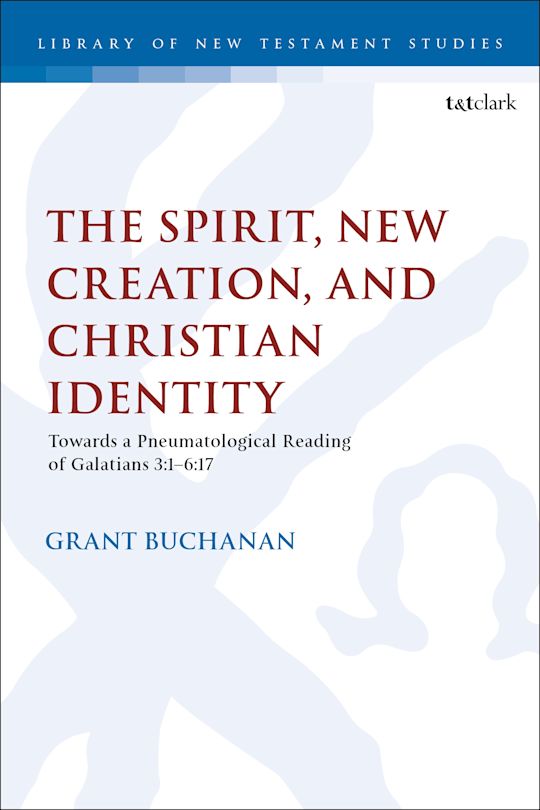
Library of New Testament Studies 681. New York: T&T Clark, 2023.
The topic of pneumatology in Paul has received significant and increasing attention over the last few decades, blossoming (worthily) into a field which is proving to yield an abundance of fruit for further understanding Paul’s soteriology and general theology, as well as Trinitarian frameworks therein. The field is significantly more expansive with Grant Buchanan’s (hereafter B) recent publication The Spirit, New Creation, and Christian Identity in Galatians. The work is a “reworking” of B’s 2021 PhD dissertation at the University of Divinity, Pilgrim College (Melbourne, AU), republished in the LNTS series. I found the work to be refreshing, exciting, easy to read, and deeply insightful, filling a pretty substantial lacuna in the scholarship and moving the importance of new creation and the Spirit in Paul into a direct focus.
B structures his study with seven chapters including a conclusion and a bibliography which runs from pp. 171-192; just over twenty pages and demonstrating a contemporary compendium of the most significant and recent works on the immediate topic and those related to it. The chaptered structure is quite simple. In chapter one (pp. 1-18), B introduces the reader to ideas about Paul, the Galatian situation, and his aims and methodology for the book. In chapter two (pp. 19-52) B provides a succinct overview of the Spirit in the Old Testament (OT) and Second Temple period (STP) literature, including Qumran, Jubilees, and Wisdom of Solomon. In the remaining chapters B dedicates each to a section of Galatians: 3:1-5 in chapter three (pp. 53-80); 3:6-4:11 in chapter four (pp. 81-112); 4:12-6:10 in chapter five (pp. 113-138), and 6:11-17 in chapter six (pp. 139-164). Finally, in chapter seven (pp. 165-170) B provides a brief summary overview, concluding findings and remarks, as well as suggestions for further research. Coming in at only 170 pages, B packs quite a punch in this succinct and insightful work.
In chapter one B jumps right in and identifies what he calls “generative cosmogenic trajectories” in Jewish creation traditions, eschatology, and apocalyptic renewal of the cosmos (p. 2) and it is within this contact that he “argue[s] that Paul’s pneumatology and new creation language are not purely anthropological (an internal, individual experience of transformation), but also represent a covenantal and cosmic transformation in which social and eschatological realities are reconfigured in the light of the crucified Messiah” (p. 6). For B, Paul is employing a hermeneutical application of the Spirit-eschatology framework laid in STP Judaism (p. 7) and that Greek philosophical traditions may have influenced the apostle’s articulation of the gospel, but that these are filtered through his received Jewish tradition (p. 9). A particular approach in his work is that he identifies 3:14 as a “linchpin” (p. 17) in Paul’s argument in Galatians, and this passage provides an immensely helpful framework and springboard for reading the epistle as a whole.
Chapter two reads quickly yet one walks away with a good background, and at times exegetical treatments, of the understanding of the Spirit in ancient Jewish literature. B’s focus is on the link between the Spirit and creation. Genesis’ cosmology is articulated in covenantal language (p. 20), the creation of man mirrors creatin (p. 23), and “These linguistic and conceptual referents that connect the Spirit to creation represent a rehearsal of the original creation narrative that reiterates the agency of the Spirit in the creative act” (p. 28). Following areas like Ezekiel, Jubilees, and Wisdom, B sees “new creation” as underlining much of the literature when foreseeing Israel’s restoration, though acknowledges the idea of new creation is only implicit in Wisdom (p. 48). From this survey B views Paul as drawing from this tradition and presenting the Spirit as the agent officiating this eschatological renewal of God’s people, which draws Gentiles into it (p. 51).
B’s thesis and tenor comes into form in chapter three following these two introductory chapters. For B, while Pauls “concepts of new creation and Spirit were fashioned from the seedbed of earlier Jewish thought,” it was :dynamically reconfigured by his experience of the risen Messiah and his resulting Christological and pneumatological convictions” (p. 53). Paul invokes the Spirit with cosmic implications, radicalizing his understanding of the Abrahamic covenant and all that God had done culminating in Christ. Thus, Paul sees the Spirit as the agent of this new revelation of what the Scriptures had foreshadowed. Since the Spirit is immediately introduced here in Gal. 3, B points out that “The importance of 3:1-5 to the overall argument has been recognized by only a minority of scholars” (p. 54). Where B differs from some is that he sees that the Spirit is not just received by way of justification by faith, but that “the emphasis in 3:2 is not on justification but on the reception of the Spirit” (p. 59). For B, which I strongly contend for, he questions if ἔργων νόμου and ἀκοῆς πίστεως are subjective genitives denoting two competing spheres (pp. 60-63), thus ascribing to the Spirit agenthood in salvation.
It is this idea which B masterfully develops, and does so quite persuasively. Seeing a chiastic structure in 3:3 and an adverb of degree in ἐναρξάμενοι πνεύματι (pp. 70-71), as well as σάρξ denoting a realm of existence, a dominion in contrast with the Spirit and eschatological in character (pp. 71-75). B’s ideas are attractive here, as he sees flesh, as in the flesh subject to the old age of Sin, as an age and dominion contrasted with the Spirit. The reception of the Spirit is therefore a cosmic and eschatological transformation for believer, and “The presence of the Spirit within and among the believers constitutes what Paul elsewhere can call ‘justification’” (p. 77). Having set up this more cosmological idea of Paul’s justification language in Galatians, B moves into chapter four and initially entertains that Paul had already utilized the Abrahamic narrative to the Galatians (p. 83), which B believes Paul does not argue here what someone does or doesn’t do but rather who belongs to whom, i.e. who are the children of Abraham and therefore God (p. 89). Returning to the subjective contrasts earlier B sees the citations of Hab. 2:4 and Lev. 18:5 functioning similarly, with the apostle “contrasting two systems of life: (p. 91). This ultimately leads to 3:14, with 14a being a purpose and 14b a result clause, with the Spirit being “not the promised inheritance but the one who produces heirs” for Abraham (p. 94), though noting the close association, and interchangeability, of “promise” and “Spirit” (p. 98). Here B sees that “According to 4:1-7, inheritance and the promised Spirit represent the same thing” (p. 102) and he articulates various views at work here.
For B, Gal. 3-4 is a continuous argument focusing on the Spirit and identity (p. 108) all with human transformation and covenantal/sonship language in an apocalyptic-eschatological context (p. 109). Thus 3:2 and 4:6 are “significant thematic bookends” (p. 111) in the argument and ground promise, inheritance, and sonship all by the Spirit. Moving to chapter five, B points out the key themes of “faith, righteousness, circumcision, works, inheritance, promise, Christ, and the Spirit” (p. 113). He briefly discusses Paul ascribing a positive, guarding view of the Law in 3:23-24 (p. 114) and moves into the allegory of 4:21-29 with a lengthy conversation, seeing Paul continuing the idea that the idea is spiritual freedom in the Spirit contra the old age of the Law in that the Spirit makes “promise children” (pp. 115-120). In this chapter B also returns to his idea of the Spirit being transforming and the contrast to the flesh, with the Spirit and flesh being two different domains working out in the un/believer’s life. These are :two soils into which the Galatian believers can sow their lives” (p. 135).
B comes to chapter six where he largely follows the arguments found in Jackson and Hubing on the themes of new creation in 6:11-17. B considers this “as the closing of Paul’s argument in the letter body, and not merely as a summary post-script as is commonly assumed,” noting similarities for a post-script but ultimately seeing Paul’s use deviate from this in the structure, recurrence of themes throughout the letter and particularly the introduction of new information (p. 140). Thus “6:11-17” is the climax of Paul’s argument toward which the whole of the letter has been heading” (p. 141), an incredibly attractive and rather convincing view. B ties in the Spirit and new creation as the focus in these passages (p. 149), taking on a largely cosmic dimension (p. 153) and the new creation motif including all three aspects of cosmology, anthropology, and ecclesiology at work (p. 156). He argues that Paul’s new creation “represents a pneumatologically empowered and shaped socio-cosmic renewal that involves spiritual transformation with a consequential radical epistemological shift, resulting in an individual, communal, and cosmic new creation,” all seeing the Spirit as central to it, drawing from the Spirit’s relationship to (new) creation in Jewish literature (p. 158).
Such may count as B’s thesis statement. In chapter seven, the conclusion, B marks out an assortment of different implications from his research, such as the discussion in Gal. 5 not being about an internal battle for a believer but a Spirit-flesh dichotomy of domains (p. 166), that 6:11-17 is the continuation of Paul’s argument and its telos, and that the Spirit ought to be seen, properly, as central to the new creations and subsequent new identity of believers in Christ (p. 168). Finally B states that his work “adds to this conversation in its claim that Paul is a generative theologian and that his pneumatology reflects a reconfigured cosmogony” (p. 169).
In my mind what B presents to us in The Spirit, New Creation, and Christian Identity in Galatians is a fascinating application of the often-ignored role of the Spirit into a dense and contested epistle with fascinating and reverberating results. B’s work is concise, well-written, novel in its claims, and paves the way for significant pneumatological studies to enter into the larger scholarly conversation. The book was one which captured my undivided attention and drew me in from page to page with details and points we could, obviously, not cover here. I struggle to think of arguments that I disagree with in the work, which is a testament to the soundness of his arguments, and I believe most would share those same sentiments. For anyone interested in either pneumatology or Galatians research, or even Pauline soteriology at large, B’s work is an indispensable treatment that will certainly make its rounds and cement its place as not only a reference work, but a wonderful and insightful read. Every reader would immensely benefit from it, and I highly recommend it, and look forward to future research and work from B.