
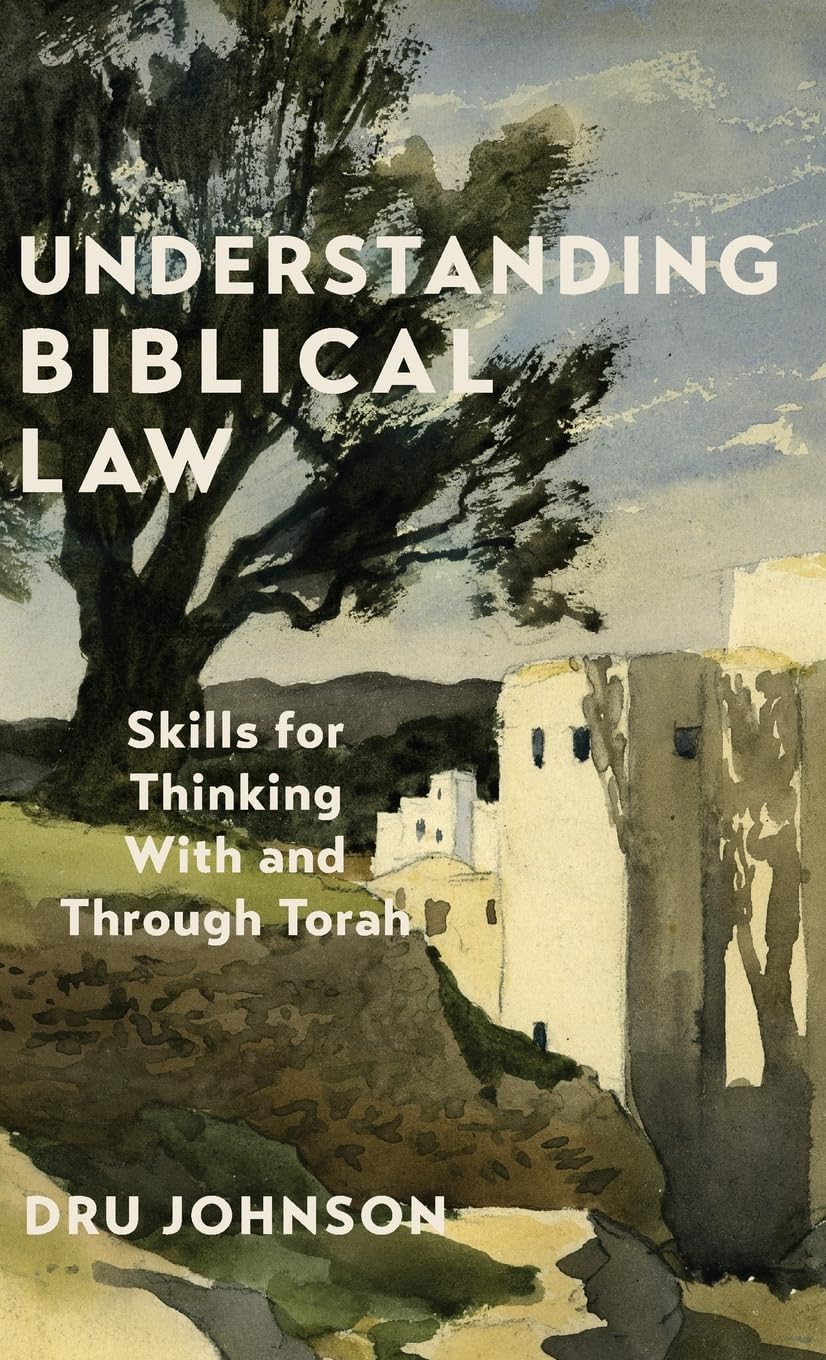
Grand Rapids, MI: Baker Academic, 2025.
There have been some exciting new publications this year (and next year) on the Law of Moses, both in its original reception (in the OT) and in its first-century reception (in the NT). Additionally, the past decade has witnessed this in many ways, with research and publications ever increasing on reorienting ourselves to, and recontextualizing, the OT Law. None, however, are quite like Dru Johnson’s new work Understanding Biblical Law. “Reorient” is a word Johnson (hereafter J) actually uses in describing one of the goals of his book, but another one is “WEIRD” (all caps, too; p. 4), by which he describes the book (and the reader!). I would agree—however, it is not just weird, but wonderful, and I find J’s work to be one of the greatest and most insightful contributions to the discussion that has hit any press, let alone a recent one. But perhaps not exactly as one would suspect. In essence, J draws the reader away from their modern idea(s) of law, judgment, and codified systems therein and into the biblical world, enabling one to reapproach the Law on its own terms, in its own context, and specifically within its own literary structure, which J frequently stresses overlaps, interacts with, and is nestled in ritual and narrative texts.
Perhaps one of the most pedagogical and interesting parts of the book is the adjoined story throughout, split into seven sections with an unexpected end, even to the bibliologist and historian. J betrays an incredible skill in storytelling, revealing how talented and gifted he is in educating an audience in a cogent, comprehensive, but compelling way. I actually found myself, at times, excited for the story sections, and it reminded me how unfortunate it is that some of us never find ourselves reading novels anymore. But what this adjoined story does is, unsuspectingly, provide a wealth of background and historical information not only to J’s larger points of the Law, but to ancient Israelite every day life (and life in antiquity in general). I will not provide any further information on the story (as to potentially reveal spoilers), but I believe that even if one was unhappy with the work itself (which, J does begin the first line proper of the book “Everything in this book could be considered controversial to one scholar or another”, p. 1) they would walk away from it having enjoyed the story. However, I would strongly recommend the work as a whole, and I believe it is an important, insightful, and incredible contribution to and for any biblical student that is approachable, affordable, and applaudable.
J’s work is a bit difficult to structurally overview, and it ends abruptly. I would (and, it is how I read it) recommend it to be read in a single sitting as to ensure that all of his various points (of which there are many) remain fresh in mind. While being academically rigorous and by no means sacrificing any quality of scholarship, the work reads as a conversation and avoids inundating the reader with a constant influx of data and citations. This is certainly the strength of the work, but it by no means fits into our typical structures and expectations (it is “WEIRD”, after all). Other than the story, J splits the work into three parts: Reorienting to Biblical Law (chapters 2-3), Exploring the Genius of Biblical Law (chapters 4-7), and Thinking with Biblical Law (chapters 8-10). In chapter one J introduces the reader to the work (and to biblical law), pressing the point that biblical law is ancient Near Eastern (ANE) law, not modern law. “Biblical law existed in its own legal cosmos, amending, refracting, and critiquing other ancient law collections in the so-called ancient Near East” (p. 9). J comments that biblical law is couched in narrative, ritual, and poetic texts, and is built fundamentally by, in, and for community. For J, “The Torah is like a proverbial parent pointing over our shoulder at the horizon, helping us discern something we can detect but cannot appreciate” (p. 12), guiding Israel “into wisdom voiced in statute, poetry, case law, and narrative” (p. 15).
Chapter two is concerned with removing false ideas of biblical law via the lens of modern law, outlining the clear differences between the two. J notes that “We will bring our cultural baggage to our readings of biblical law, our ideas about what law is for, and how we think it should function” rather than within its original context (p. 27). J argues that the Torah provides laws guided by precedents and common or customary ideas (p. 28) and primarily “opens with positively oriented instruction” (p. 30), guiding Israel rather than restricting them (p. 31). These ideas attempt to maintain biblical law as primarily common law in the ANE and not, contrary to popular belief, as legal-statutory injunctions and, therefore, legalism (pp. 32-37). Biblical law has a particular slant towards protecting the vulnerable (pp. 41-43), including animals (p. 44). In chapter three, J sets out to “myth bust” common ideas about biblical law, many of which (myths, that is) “often come from the pressure to project legal ideas onto biblical law or simplify the purpose of law to a singular agenda” (p. 51). This, however, fails to recognize that biblical law is not a list of “dos” and “don’ts”, which is difficult to find in both general and specific statutes (p. 53). J provides a fresh rebuttal of the apparent antithesis between “rules” and “relationship” (pp. 53-58) as well as an excursus on misunderstanding the Pharisees (pp. 55-57), adding that “KEEPING the law in biblical texts is something akin to TENDING to its constructive and instructive methods” (p. 58), similar to guarding (p. 59), pit against typical ideas of “keeping” and “breaking”. This is an important distinction to make, and quite true, but one feels that this point deserves significantly more information and explanation than J provides. This subjects his work (as it does frequently and throughout) to criticism, and it may have been helpful for J to had devoted some academic and supportive legwork in footnotes.
Nevertheless, the rest of the chapter is spent dissuading the reader from the idea of the biblical law is harsh and punishment-based, with J offering wise insight into the prevailing fact that in biblical law “the transgressor’s life appears to be secondary to the threat they might pose to the mission of Israel” and that rather than cruel, “execution seems to function as a protection for the community” (p. 62). This considerate approach demonstrates its importance, particularly in the oft-challenged passage in Deuteronomy 21:18-20, which details a father and mother bringing forth their “stubborn and rebellious son” for communal execution (i.e., stoning). Evidencing J’s careful and learned scholarly acumen (which is threaded throughout the whole work indeed), he points out succinctly how in an agrarian society with limited resources, which were almost always under threat, and the passage’s remark of the son being a “glutton” and a “drunkard,” this man would be a threat to not only the family’s survival, but also to the community and nation as a whole given how they relied on one another for trade and assistance (which J outlines in the story well, and comments on relevant passages throughout; pp. 63-64). J’s emphasis in this chapter and others is on the original context in which the biblical law was received and executed, and this example is a perfect one at how this proper contextual approach solves multivalent issues we are often faced with, both with and amongst ourselves and in apologetics. These types of points serve as representative of the work as a whole (but are too many to mention).
In chapter four J distances the biblical law (BL) from ANE and, further, modern law. BL “operated in a different atmosphere, breathing ancient airs to which we no longer have access to” (p. 77), and that “Biblical authors play with the structures of common law in the ANE” (p. 78), but is markedly different in significant ways, particularly in its prioritization of the vulnerable populations irrespective of class or status. BL is principle-structured and based, similar to common law in its sense as “part of the legal thinking and process” and for the sake of “guidance rather than statutes to be enforced” (p. 81), displaying significant departure from the prevailing legal codes and systems of the ANE (pp. 84-88). Moving to chapter five J gives an overview and introduction to the ritualistic tune of BL, connecting closely the sanctity of God’s temple and presence in their midst and their individual and communal justice—in this, J argues that BL makes the relationship between the two holistic, with Israel’s story with God (and his goodness to them, and expectation of goodness) being projected onto BL and, therefore, onto the instruction BL provided. These two chapters (four and five) are a bit sporadic if one is looking for a specific and unique point, but this seems by design: they are thought provoking, reorienting, and contributive to the larger point of the book, working in complimentary and conjunctional fashion with the rest of the title. In chapter six, continuing this theme, J elaborates on how BL reasons with Israel (and us), causing its recipients to dwell and meditate (reason) on ethics, their responsibilities to community and creation, and on “the nature of Hebrew justice/righteousness” (p. 109). The various statues cause the recipient to naturally extend the expressed principles beyond what the text simply describes, and “This style of instruction is meant to provoke inductive reasoning, where readers find a pattern in the stated concrete instances and then extend the logic of that pattern to other instances of logical kind” (p. 110).
Here J moves into developing his points further as the book naturally unfolds. Taking as critical to understanding BL, the principle-and-instance (as J titles it) reasoning works for general as well as specific statutes, yet “We must always ask, Is this a specific rule or a more general principle? If specific, then we need to find the principles that it specifies. If general, then we need to assess the concrete instances that may be found in linked narratives and laws” (p. 113). This serves as an example of J’s thoughts, challenging the reader to think with BL just as Israel would have had to (or God had intended them to). Lists were paradigmatic in being extendable and extrapolatable (pp. 113-114), instances give way to principles (pp. 114-116), and “All instructions, broadly principled or narrowly specific, required a Hebrew’s maximal intellectual effort to understand how they might function in coordination, which laws take priority, and if there is intentional supersession” (p. 116), with specific laws often working together with “corresponding principles to flesh out what the principles intend in scope and legal extension” (pp. 116-117). Points like these are incredibly important and aptly represent and are concurrent with the history of BL interpretation, particularly in rabbinic literature. J applies this general concept to “eye for an eye; tooth for a tooth” ideas (another oft-challenged and contentious part of BL), showing how this idea prevailed over a literal application, and indeed that a literal application is not only unadvised in the OT, but directly contradicted by instruction on how this system would flesh itself out (pp. pp. 117-119). J finishes the chapter out with a fascinating and brief correction (or, proposal) to Exodus 21:21 and the meaning of “the slave is the owner’s property.” Here J proposes that a proper understanding is, as he writes, “I take the author to mean by this phrase—which literally says that the servant is “as silver to him”—that Hebrews who harm servants harm themselves” (p. 120), as harming the slave (which J clarifies would be someone in willing indentured servitude) would be the loss of the slave’s work for the master, and thus be both foolish and at constant risk of forced release of the slave for extreme harm (as well as the slave crying out to God and God killing them [the master(s)] with the sword [Exod. 22:23-24]).
In chapter seven J demonstrates how BL is constructed and informed by narrative, and that BL naturally instructs within this context, both drawing from examples in its previous attached literature (e.g., Genesis) and differing significantly from ANE law not only in this regard but in its consistent switching to the second-person, placing the recipients of BL (i.e., Israel) in direct relation (and experiential reference) to the statutes. This short but succinct chapter is interesting, and provides insight (but undeveloped by J) for how this “principle” plays out across the Torah (Genesis-Deuteronomy) and the rest of the HB corpus (a principle Paul applies in 1 Cor. 10). In chapter eight J challenges the reader to think with BL, with the agrarian lifestyle and some further contextualization of Baal worship (p. 143), the familial and communal place of legal jurisdiction (p. 144-145), and its place in prohibiting (or, at least restricting and preventing significant abuse) abuse of those who are vulnerable (pp. 147-150). This chapter provides sections for “practicing the skill” that BL presents, and is pedagogical for this purpose, and effective if people interact with these sections. In chapter nine, which is one of, in my mind, the best sections, J challenges the reader to think through the surrounding narrative which frames BL as a whole and specific statutes or passages. As he comments, “The less you understand about the way the Pentateuch speaks and thinks, as it were, the more obtuse these laws will seem” (p. 152) and he applies this both to “clustered” instructions, drawing out implications for their individual and combined meaning(s) (p. 153-158) as well as highlighting the importance and function of repetition in BL (pp. 161-162), as well as (which he explains carefully) chiasmus structures found throughout the literature (pp. 163-166). This chapter, at least, ought to be required reading for all BL students, but it beautifully compliments and is resultant of the preceding chapters, capstoning, as it were, what J has since built up towards.
Finally, in chapter ten (which does, admittedly, end the book abruptly; but likely by design), J calls the reader to develop “theological skills”, which he explains are “the collection of sensitivities that helps readers prioritize the recurring ideas pixelated across the Pentateuch” (p. 173) and that which he has sought to cultivate in the work. This collection of skills actually enables us to understand law more broadly (ibid.) and enables us to properly approach the HB and BL. The chapter somewhat functions as a conclusion and summary chapter, recapitulating various ideas expressed throughout the book and reiterating the importance of developing the skills J has covered, enabling us to properly approach BL, understand manifold actions towards BL found in the NT, and enrich our readings in many ways. In this light, the chapter does end the book well, but the book, as a whole, simply doesn’t “read” the way we expect books to, but this is in many ways its value and essence. In sum, as this review could hardly cover the surface of all that J deliberates upon and draws from the text, Understanding Biblical Law is a promising and immensely beneficial work to layperson, student, and scholar alike in reorienting ourselves towards BL and, unexpectedly, enabling ourselves to properly apply BL to our own, modern lives. I think this work is satisfactory (when its intentions are taken into consideration) to and for any reader, and that it would be wonderful in a church, bible study, or small group setting, not just for reading and self-enrichment. J would probably do well, actually, to provide some type of interactive and expansive guide to the work for the intent of small groups, and I think that would be an awesome addition to the work and something he (from what I can gather from the work) would enjoy doing. The work is affordable and expansive, and undeniably deserves its spot on every biblical student’s (armchair or professor) bookshelf, as well as being an invaluable resource for those interested in, perplexed over, and indecisive towards BL.
The publisher, Baker Academic, kindly provided me with a complimentary copy of the book. My opinion and review of the work was in no way affected or influenced by that, and my comments reflect my honest views of the title.